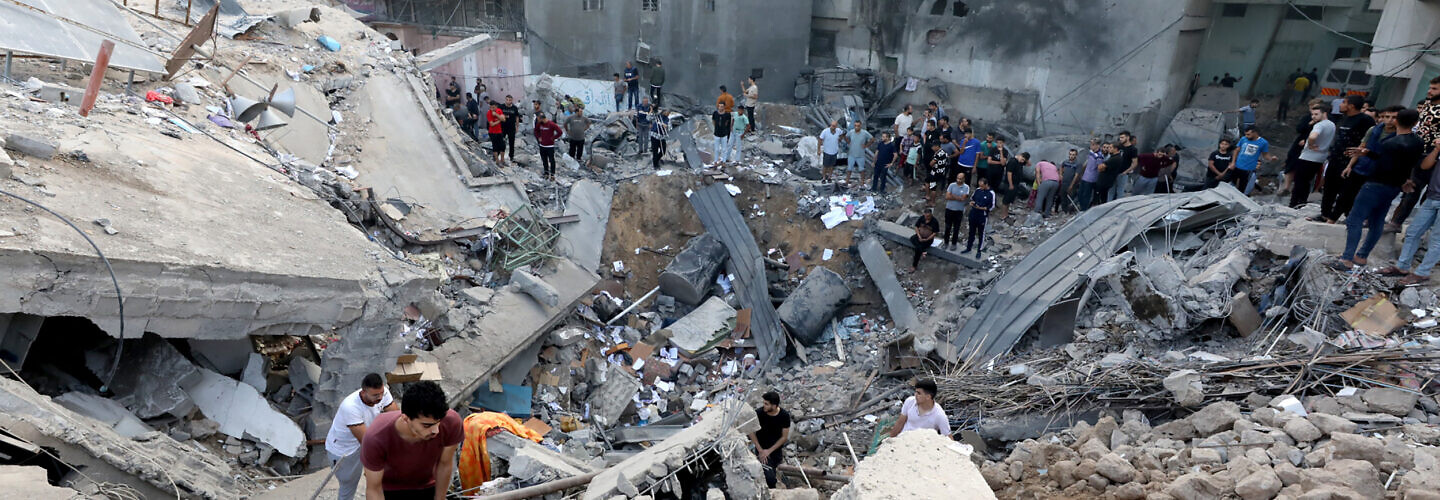
The destroyed annex of the Greek Orthodox Saint Porphyrius Church, which was damaged in an Israeli strike on Gaza City on October 20, 2023. (Photo by Dawood Nemer/AFP via Getty Images)
While Israel wages war against Hamas in Gaza and Russia pursues its war in Ukraine, an egregious yet potentially overlooked assault may be under way in both contexts.
Amid the massive loss of life and displacement in Gaza, as well as the burgeoning humanitarian catastrophe, over 100 ancient cultural or archaeological sites in the Strip were partially damaged or destroyed in the first thirty days of the war, according to a report published by the NGO Heritage for Peace. The number could now be closer to 200 sites damaged or destroyed, though the active conflict hinders complete assessments and verification by specialists. The 13th-century Great Omar Mosque and the 12th-century Church of Saint Porphyrius, where hundreds of Palestinians had been taking shelter, were both among the wreckage. The Greek Orthodox Patriarchate of Jerusalem accused Israel of intentionally targeting the latter, though Israel has denied intentionally targeting some cultural sites, including the church. Yet the destruction of ancient Palestinian heritage demonstrates the threat the conflict poses not just to Palestinian lives but to Palestinian culture and identity.
In Ukraine, Russia has targeted and damaged or destroyed 351 protected Ukrainian cultural heritage sites since the invasion began, according to UNESCO. Although not all heritage sites can be definitively confirmed as intentional targets, a UN report issued by the Office of the High Commissioner for Human Rights (OHCHR) asserts that Russia is intentionally targeting certain cultural heritage sites, including attempts to erase local culture, history, and language in occupied territories. Russian forces have also reportedly looted Ukrainian art and artifacts from museums across the country, according to the Ukrainian government and independent United States researchers.
The Targeting of Cultural Heritage by State Actors
The destruction of cultural heritage by states is not a new phenomenon. It is a tactic that has been used throughout history and has occurred in many conflict zones beyond Ukraine and Gaza, including recently in Syria (allegedly by the Syrian regime) and Nagorno-Karabakh (by Azerbaijan). The act encompasses but is not limited to the looting or trafficking of artifacts, the physical destruction of cultural sites or objects, and the systematic erasure of intangible cultural heritage, which includes traditions or living expressions of culture passed down by ancestors. This intentional destruction is not limited to states, as illicit actors, including terrorists and organized criminal groups, have been known to target and destroy cultural heritage. Illicit actors’ involvement in this issue has often been the focus at the multilateral level, such as in the UN Security Council. This article seeks to explore the particular complexities of more recent state involvement and propose potential remedies. Read more