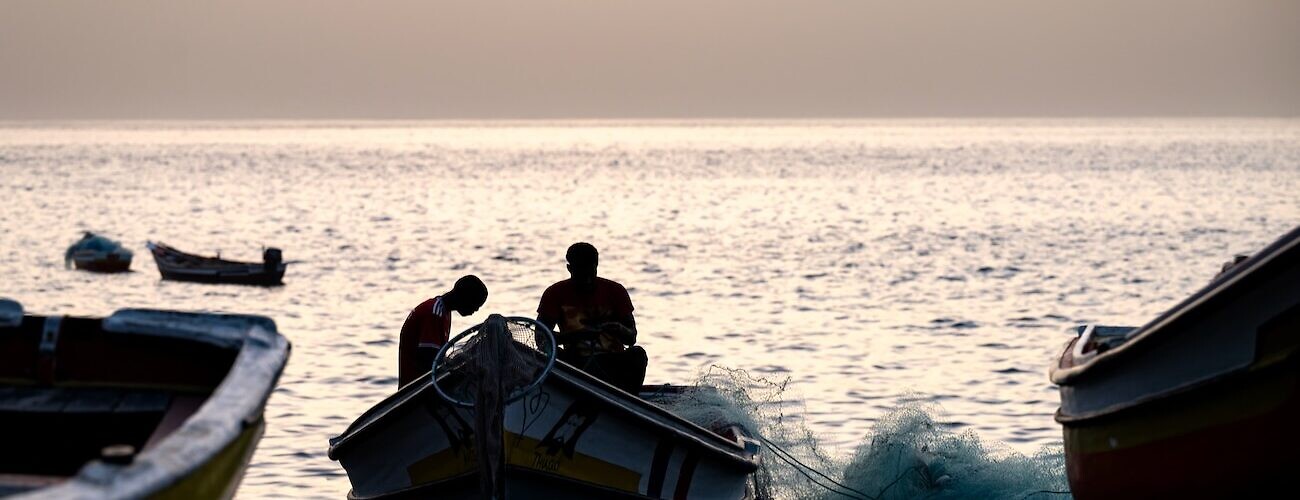
Two fishermen in their boat in Rincao, Cabo Verde, December 9, 2024. UN Photo/Mark Garten.
Seven years ago, Chile promoted COP25 as a “Blue COP,” helping secure a formal dialogue on the ocean–climate change nexus. COP26 subsequently made that dialogue annual. Now, some are again calling COP31, opening in Antalya, Türkiye, on November 9th, a “Blue COP.” The presidency has made oceans and seas one of 10 priorities in its voluntary Action Agenda, emphasizing coastal resilience, blue carbon, ocean observation, and data sharing. The growing attention could help protect marine ecosystems and coastal livelihoods.
But without attention to who controls investment and decisions, ocean initiatives risk advancing the commercial and strategic interests of powerful states and corporations while subordinating the needs of less-resourced states and ocean-dependent communities. That would reproduce the inequitable colonial relations that have long shaped vulnerability to climate change and the response to it.
This year’s ocean and climate change dialogue called for stronger links between national climate plans, biodiversity protection, and ocean governance, including closer cooperation between the Paris Agreement and the agreement on marine biodiversity beyond national jurisdiction (BBNJ Agreement). Participants also called for greater attention to mitigation, highlighting ocean-based renewable energy and maritime decarbonization as key opportunities while discussing port electrification, green hydrogen, and green maritime corridors.
These proposals connect ocean-based mitigation with debates about a transition from a “gray” to a “blue” ocean economy. The “gray” ocean economy represents a business-as-usual model of market-driven governance, which drives environmental degradation and concentrates wealth and control. Corporate revenues accrue disproportionately to a small number of firms, while marginalized groups face dispossession and restricted access to ocean spaces and resources. Exclusion from decisions and the devaluation of their knowledge and worldviews limit their influence over development, while social and racial hierarchies help justify harm to their lives and livelihoods. Proposals for a “blue” economy promise a more sustainable and equitable alternative, but the term remains politically contested. Critics warn that market-led blue growth can repackage capitalist accumulation and inequitable power relations under the “blue” label, lending legitimacy to activities that continue to degrade our natural environment and undermine the livelihoods of those who depend on it.
The Politics behind the Blue Label
Article 2(2) of the Paris Agreement requires that its implementation reflect equity and common but differentiated responsibilities and respective capabilities, in light of different national circumstances. Wealthy industrialized countries have consumed a disproportionate share of the carbon budget, while many Global Majority countries, particularly small island and least developed states, bear little historical responsibility but face severe impacts with fewer resources to respond.
These inequalities also shape climate action, including the energy transition. The “Climate Inequality Report 2025” shows how concentrated wealth gives asset owners the power to influence the direction of energy systems. Oxfam’s “Unjust Transition” warns that the shift away from fossil fuels can reproduce colonial patterns of exploitation through debt burdens, unequal energy access, and investment that prioritizes powerful actors’ interests.
Farhana Sultana’s concept of “climate coloniality” connects the historical roots of climate inequality with the power relations shaping the response. Colonial forms of domination persist after formal colonial rule, shaping vulnerability, knowledge, and responses to climate change. The “colonial matrix of power” connects control over capital and labor with political authority, hierarchies of knowledge, and racialized judgments about whose lives and environments are expendable. Climate action can reproduce these relations when it secures new markets for powerful actors while placing the costs on marginalized communities.
This framework extends the analysis beyond a Global North–South divide by tracing colonial relations within states. Wealthy countries can benefit from an unequal global order while continuing to reproduce racialized and settler-colonial hierarchies within their borders. Those hierarchies shape whose knowledge is recognized, who has authority over land, waters, and development, and which peoples and places are marginalized or treated as expendable.
Within the UN Framework Convention on Climate Change (UNFCCC) process, coloniality is evident, for example, in smaller states’ unequal negotiating capacity to participate meaningfully across its complex agenda. Expanding discussions on oceans without addressing such structural barriers could give well-resourced delegations greater scope to define priorities and influence the terms of implementation.
Such differences in influence particularly shape the interpretation and implementation of the Paris Agreement’s requirement for equity. The Just Transition Work Programme (JTWP) provides a forum for debating how transitions should address inequality, but what equity requires in practice remains contested. A central question is whether this transition can take place within existing power structures (an accommodative approach) or whether it requires changing the financial and institutional arrangements governing investment, technology, and decisions (a transformative approach).
The transition toward offshore renewables and the decarbonization of shipping show why this distinction matters for the oceans agenda. Both offer opportunities to cut emissions through investments that can leave ownership and decision making concentrated in established actors’ hands. Those actors can also exercise disproportionate influence over the priorities and terms of climate action pursued through COP31.
Offshore Wind’s Unequal Expansion
Offshore wind can reduce fossil-fuel dependence and support the renewable-energy expansion called for in the Paris Agreement’s first Global Stocktake. Yet while leasing and project approvals remain domestic decisions, less-resourced countries need access to finance, technology transfer, and capacity building to participate equitably in this energy transition. These “means of implementation” provide a practical test of equity between states under the Paris Agreement.
Research on offshore wind in “emerging” markets identifies finance, skilled workers, port infrastructure, and access to technical knowledge as important conditions for building domestic supply chains. An OECD assessment of the Philippines warns that reliance on imported components can create bottlenecks and geopolitical dependence, while the country competes with other markets for vessels, skills, and capital. International support that mobilizes investment without building domestic capabilities risks leaving these dependencies in place. Its contribution to equity therefore depends on whether it strengthens countries’ capacity to negotiate project conditions with foreign investors and sovereignly shape the terms of the transition.
Yet even greater national agency in negotiations does not guarantee an equitable energy transition within countries. A global study highlighting coastal energy opportunities in Oceania, South America, Southern and Eastern Africa, Western Australia, and the Arctic found that financial institutions tend to focus their investments in already energy-rich regions, leaving marginalized communities without adequate access to electricity. Without prioritizing underserved communities’ energy needs and control over their energy systems, expanding renewable energy generation can leave inequalities in energy access unresolved.
Procedures intended to include people in project planning can also undermine the participation of marginalized communities. A 2022 study of public comments on two offshore-wind proposals in the northeastern United States found that non-Indigenous participants appropriated or sidelined Indigenous concerns to advance pro- and anti-wind agendas, with some comments framing Indigenous interests as obstacles to addressing climate change.
These procedures could be more participatory if they incorporated processes allowing communities to document how they use and understand marine space. In Ceará, Brazil, such a process revealed overlaps between proposed offshore-wind projects and traditional fishing communities’ territories and routes, challenging assumptions that these spaces are available for investment. To be transformative, this local knowledge must inform whether and where projects proceed, rather than merely inform how their impacts are managed after investment priorities have been fixed.
The Unequal Terms of Cleaner Shipping
Similar questions about finance and control arise in shipping. While international emissions rules are negotiated at the International Maritime Organization (IMO), the IMO’s strategy for reducing shipping emissions is grounded in the Paris Agreement’s 1.5°C goal, and the UNFCCC receives reports on its work. Alongside IMO negotiations on decarbonizing shipping, COP31 could help mobilize political support, finance, and partnerships for cleaner fuels and ports.
Research on barriers to investment in cleaner shipping has found that the potential early movers are mostly wealthier countries, while many of the states that are most vulnerable to higher transport costs or climate change have limited opportunities or capacity to use funding for cleaner ships, port infrastructure, or marine fuels. An IMO emissions-pricing scheme that channels revenue only toward commercially ready fuel and port projects could therefore reward states with existing advantages. An equitable scheme would redistribute revenues to address these investment barriers and offset the disproportionate burdens that higher shipping costs could impose on vulnerable states, including through rising prices of essential imports. Recipient states should have direct access to funds and, alongside affected communities, share authority over their allocation and use so that spending reflects their own priorities.
Yet the rules that would generate these revenues and establish a fund to mitigate impacts on vulnerable states have faced opposition from powerful actors. After the IMO approved a Net-Zero Framework in April 2025, the United States threatened retaliation against countries supporting the framework, explicitly citing its energy and shipping interests. Several major tanker companies have also opposed the framework in its existing form. When countries could not come to an agreement on the framework in October of that year, Saudi Arabia requested a vote to adjourn the meeting for a year, an outcome welcomed by some marine-fuel traders. Negotiations are now set to resume in December.
The transition to cleaner shipping must also address inequalities within the industry, including labor hierarchies. The Maritime Just Transition Task Force, launched at COP26, promotes training for alternative fuels, gender inclusion, decent work, and social dialogue. Delivering these commitments requires confronting enduring racialized recruitment and wage hierarchies affecting seafarers from the Global Majority and gender hierarchies in maritime education and training that marginalize women. Reskilling on its own will not resolve precarious contracts and reliance on low-paid crews with limited bargaining power. A transformative approach would change how seafarers are recruited and paid, strengthen the enforcement of their rights, and give marginalized workers collective authority over their working conditions.
Redistributing Power beyond Ocean Governance
Across offshore renewables and clean shipping, governments’ pursuit of industrial advantage influences the direction and pace of decarbonization. Research on Norway’s offshore-wind development shows how petroleum interests helped shape the sector. Equinor’s publicly supported Hywind Tampen offshore-wind project supplies electricity to oil and gas installations, reducing emissions from oil and gas production while extraction continues.
Pursuit of energy security is also having a growing influence on decarbonization efforts. Risks of war and disruption at maritime chokepoints have pressured governments to pursue renewable energy. The shipping industry has pursued efficiency measures, electrification, and renewable fuels to reduce exposure to oil-price shocks. These efforts can reduce emissions but may not redistribute ownership or decision-making authority.
A genuinely equitable blue economy requires restructuring global decision making so that less-resourced states and excluded communities have greater authority over the financial and economic rules shaping climate responses and their livelihoods. This entails reforming representation and decision making within the UN system and international financial institutions, alongside lending and debt rules that restrict countries’ choices.
Democratizing global governance must be matched by democratic control over public investment and ownership within countries. Policies should give communities and workers a role in decision making over public investment and the assets it finances so that energy and transport systems serve human needs within planetary boundaries. Military budgets reveal how far current priorities diverge from these aims. Global military expenditure reached almost $2.9 trillion in 2025, its 11th consecutive annual increase. This spending sustains arms-industry revenues, while military activities inflict lasting damage on communities and ecosystems. Redirecting resources from militarism toward mitigation could make public funds available for clean energy and transport without creating new debt burdens and dependencies.
These proposals challenge governments’ strategic priorities, creditors’ leverage, and the advantages of incumbent industries. War and geopolitical rivalry strengthen demands for military spending and control over strategic resources. Authoritarian nationalist politics further obstruct redistribution when they justify protecting privileged populations through fortified borders and resource grabs. Realizing these proposals will thus require coalitions able to advocate for these priorities in international negotiations and domestic politics. At the IMO, a group of small island and least developed states helped sustain negotiations on the Net-Zero Framework’s implementation guidelines after the 2025 adjournment. Connecting such state coalitions with organizing by workers, Indigenous peoples, and coastal communities could strengthen pressure on governments both when they negotiate international rules and when they implement them at home.
What COP31 Can Contribute
COP31 offers a forum for pursuing these demands, although the UN climate process is itself shaped by the interests being challenged. Negotiations over finance and implementation, alongside voluntary partnerships associated with the summit, could begin to change the terms of ocean-based mitigation. Negotiated decisions and voluntary commitments should be distinguished, and both assessed by whether they give less-resourced states and affected communities greater authority over these transitions. Offshore leases, shipping rules, and employment rights will nonetheless still depend on action by national legislatures and other international institutions.
Questions about ownership, access, and costs should inform climate finance negotiations and guidance to climate funds, grounded in developed countries’ Article 9 obligations. The Green Climate Fund and the Global Environment Facility already support a range of ocean-based initiatives. Yet transformative equity depends on whether negotiated outcomes change who can access that funding, the conditions attached to it, and who decides how it is used. Wealthy countries should provide grants and address debt burdens so that recipients can pursue locally determined priorities, access technology, and build lasting technical capacity. Public financing should enable public or community ownership. Governments should make communities’ and workers’ decision-making rights enforceable through national laws and project agreements, while funding institutions should require project developers to uphold those rights.
International cooperation could help countries put these commitments into practice. Following the September–October workshop on the JTWP, negotiations to operationalize the just transition mechanism offer an opportunity to organize technical assistance, capacity building, and knowledge sharing. The design of the mechanism should enable workers and affected communities to help set priorities for assistance, including support for collective bargaining and Indigenous peoples’ free, prior, and informed consent.
The multi-year roadmap proposed for the ocean dialogue could make equity a recurring focus of future dialogues. Alongside outcomes on emissions and ecosystems, these discussions should examine infrastructure ownership, access to affordable energy, and effects on coastal livelihoods. They should also assess whether Indigenous and local knowledge informs project decisions. Less-resourced states must be able to influence how these questions are framed and assessed, which requires financial and technical support for their delegations.
Governments and funding partners should state when promised finance will reach recipients and which institutions will implement agreed changes in ownership and decision making. Public reporting should allow affected communities to verify whether those commitments have been fulfilled. However, these measures should not replace faster emissions cuts by countries with high historical or current emissions.
Ultimately, a Blue COP should be judged by whether it helps transfer authority and resources toward those whose needs have systematically and unfairly been subordinated. Without that shift, greater attention to the oceans risks reproducing the colonial relations of the “gray” ocean economy under a “blue” label.