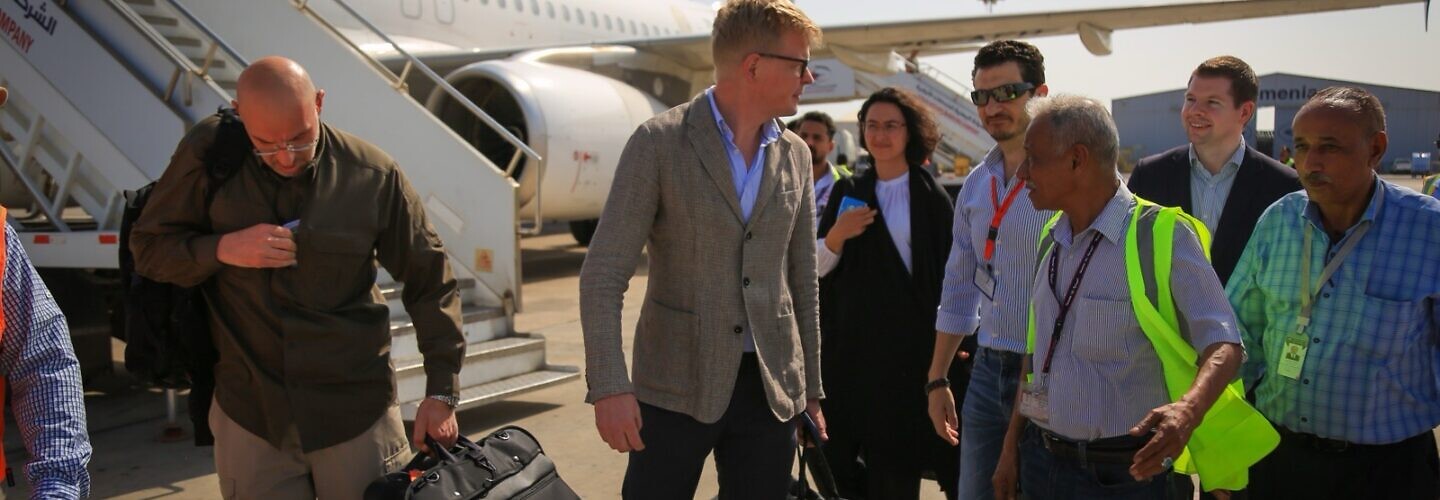
UN Special Envoy for Yemen Hans Grundberg visits Aden, April 9, 2026. OSESGY.
Over the past month, Yemen’s conflict has escalated once again, ending a period of relative calm that had prevailed since the 2022 truce. The renewed fighting between the government of Yemen and the Houthis (also known as Ansar Allah), Houthi cross-border attacks on Saudi Arabia, and threats to Red Sea shipping loom large over the long-suffering people of Yemen, regional security, and the global economy.
The inconclusive outcomes of previous escalations suggest that this round of fighting will not lead to a military solution to the conflict in Yemen. Despite having control over the capital, Sanaa, since 2014, the Houthis controlled only around a third of the country’s geographic area prior to the latest escalation. Similarly, the government of Yemen has never delivered on its longstanding rhetoric about retaking significant territory from the Houthis, as repeated in the latest announcement of a counteroffensive.
The UN special envoy for Yemen, Hans Grundberg, repeated in his September and October briefings to the UN Security Council that working toward a political settlement is the only viable way out of the conflict. Until now, the conflict in Yemen has typified the frustration evident in the UN secretary-general’s recently published review on the future of UN peace operations, which pointed to the proliferation of “stop-gap solutions, such as ceasefires and truces,” rather than long-term peace agreements.
Why a Long-Term Political Deal for Yemen Is Needed
The 2018 Stockholm Agreement and the 2022 truce, as well as the diplomatic understandings between the Houthis and Saudi Arabia and between the Houthis and the US, were all partial in nature and have not served as a bridge toward negotiations on a final peace settlement. The major upheaval in the aftermath of the attacks of October 7, 2023, and the conflict between the US and Iran have also shown how vulnerable these types of deals are in such a politically volatile environment.
These agreements have had benefits. Between major escalations, they have kept the front lines relatively stagnant for months or years at a time, particularly following the 2022 truce, giving Yemenis relief from the prospect of physical harm or displacement. But stagnant front lines have not delivered sustained economic revival or improvement in basic services. Conditions for the Yemeni people have continued to deteriorate, and the division between institutions in Houthi- and government-controlled areas has become more entrenched.
The gap in political leverage between the parties has also gradually widened, complicating efforts to find a political solution. The Houthis have deepened their ideological and security grip on the areas under their control, expanded their military capability and reach beyond Yemen’s borders, and enhanced their networks in the Horn of Africa. By contrast, the pro-government umbrella—recent consolidation efforts notwithstanding—has lacked internal cohesion, most notably in the relationship with the southern pro-independence movement.
With temporary solutions proving unsustainable and the threats to long-term peace expanding with time, this is an opportune moment to commit to supporting efforts to forge a long-term peace.
The UN’s Mediation Role Has Evolved but Remains Critical
In line with Security Council Resolution 2216 (2015), the UN special envoy’s role is to exercise the good offices of the secretary-general to enable “the resumption of a peaceful, inclusive, orderly and Yemeni-led political transition process that meets the legitimate demands and aspirations of the Yemeni people, including women, for peaceful change and meaningful political, economic and social reform.”
The envoy’s role was at the fulcrum of diplomatic efforts during the Kuwait talks of 2016, the Stockholm Agreement in 2018, the 2022 truce, and major prisoner exchanges. As Grundberg alluded to in his September briefing, the UN still maintains the Military Coordination Committee, a mechanism for engaging on military de-escalation between the government of Yemen and the Houthis. Over the past five years, the special envoy and his team have also conducted rounds of inclusive consultations with Yemeni stakeholders on the big-picture issues that need to be addressed to achieve lasting peace.
But the mediation space has also become more crowded. Saudi Arabia engaged publicly with the Houthis for the first time in 2023 in an effort to achieve consensus on a framework for the way forward to a political settlement. Oman helped bring the Houthis together with Saudi Arabia and facilitated their direct engagement with the US in 2025 to de-escalate the situation in the Red Sea. In the wider region, Pakistan has been liaising between the US and Iran, and China mediated an entente between Saudi Arabia and Iran in 2023. This month, Iran has added its voice to the mix by offering to mediate between Saudi Arabia and the Houthis.
The increased intertwining of Yemen’s conflict with regional and maritime security adds a further layer of complication. There are many pieces that need to fall into place in the region to create momentum for a political settlement in Yemen. This complex landscape necessitates strong coordination between the member states attempting to stabilize the situation in the region and the UN peace effort in Yemen to avoid duplication.
Changing the International Framework Is Too Costly in the Short Term
Many analysts have questioned whether the international framework—ostensibly based on Resolution 2216, the 2011 Gulf Cooperation Council (GCC) Initiative, and the outcomes of the 2013–2014 National Dialogue Conference—remains suitable for resolving the conflict. These three documents were generated in very different circumstances from those of today. The balance of power on the ground has fundamentally shifted, institutions have degraded and divided, and over a decade of war has heaped further injustices onto the historical wrongs that the National Dialogue Conference was meant to address.
But just as the reality on the ground has changed, so has the way UN envoys have framed the path to a political solution. UN envoys have reduced references to the GCC Initiative and National Dialogue Conference outcomes in Security Council briefings since 2015, as well as references to the Council’s demands in Resolution 2216 for the Houthis to withdraw forces and hand over seized weapons. The basis for returning to negotiations that Grundberg proposed in his September Council briefing has evolved considerably from the basis proposed by a previous UN special envoy in his August 2016 briefing to the Council, soon after the end of the Kuwait talks.
Another factor to consider is Security Council dynamics. Despite the deep divisions in the Security Council in recent years, the Council has remained relatively united on the UN’s role in Yemen compared with other conflicts in the region. Negotiating a new Council resolution that defines new parameters for the UN’s mediation efforts against the backdrop of military escalation within Yemen, the US–Iran conflict, and divisions among Council members on other major issues would deepen divisions on Yemen.
As Jenna Russo pointed out elsewhere on the Global Observatory, the recommendation in the secretary-general’s review that the Council define an end state may ignore the reality of how hard it is for the Council to reach consensus on one. In the case of Yemen, it would arguably be better for the Council to back the UN special envoy’s approach and use a new Security Council resolution at a later stage to rally around an end state defined by Yemeni stakeholders.
The New UN Secretary-General Must Be Bold in Their Support
The new UN secretary-general will arrive in the role with the UN embroiled in budgetary and restructuring challenges. Nevertheless, a bold approach to the Yemen file will signal a desire to make progress on the core peace and security function of the UN.
Building on the recommendations in the review of peace operations, the new secretary-general should vocally and publicly back the UN special envoy’s role through proactive and timely engagement with the Security Council, Saudi Arabia and other GCC member states, and Iran, as well as other member states.
Through this engagement, the secretary-general should seek to defend the space for the envoy to implement the UN’s good offices mandate; back the envoy’s specific approach to mediating the conflict, including the mechanisms for engagement with the parties as well as the inclusion of women, youth, and civil society; and underline the need for any member-state interventions to feed directly and explicitly into the UN’s mediation effort. They must also work to secure the unconditional release of all 72 UN staff detained by the Houthis, many of whom face serious health problems. Moreover, as observed by Daniel Safran-Hon, sustaining this approach will require reenergizing the Department of Political and Peacebuilding Affairs (DPPA) at the highest levels to reinforce the envoy’s engagement both at headquarters and in capitals.
In his review of peace operations, the secretary-general observed that “the United Nations must be ready to try again; there is no alternative.” This observation undoubtedly applies to Yemen. Many Yemenis and international observers are deeply skeptical about the prospects of a political settlement. The way forward to achieving basic consensus on the parameters and structures for a sustainable political solution is unlikely to be linear.
But the parties have pursued military conflict for more than a decade, and this has only made things worse. The Yemen conflict has increasingly touched on the core national security and economic concerns of countries in the region and far beyond. Though success is far from guaranteed, the attention and backing of the new secretary-general for a negotiated settlement is a political imperative for Yemen and the UN’s peacemaking role in the world.
Peter Rice is an independent political and humanitarian affairs consultant. He served as Yemen International NGO Forum Coordinator with CARE between 2011 and 2014 and with the Office of the UN Special Envoy for Yemen between 2016 and 2024.