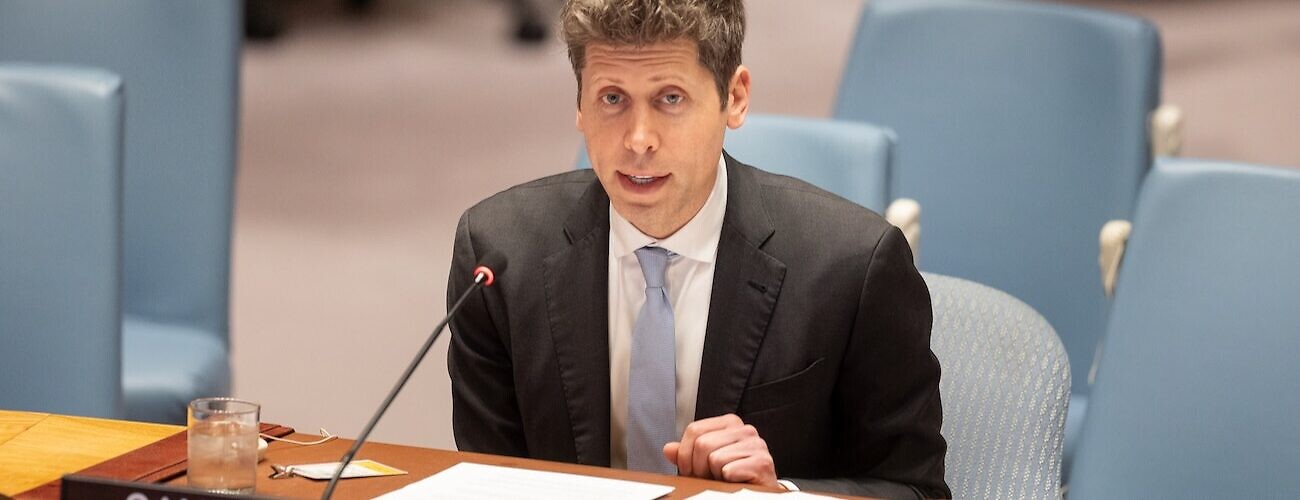
Sam Altman, CEO of OpenAI, briefs the Security Council meeting on AI and international security, September 23, 2026. UN Photo/Ariana Lindquist.
On September 23, 2026, the chief executives of OpenAI, Anthropic, and Hugging Face took seats at the UN Security Council. They were participating in a high-level briefing on artificial intelligence (AI) and international security convened by France during the General Assembly’s high-level week. French Foreign Minister Jean-Noël Barrot chaired the meeting. Yoshua Bengio, co-chair of the UN’s Independent International Scientific Panel on AI, told members that AI beyond human control is a threat that no state can contain alone and that does not respect borders. It was the Council’s first meeting devoted specifically to the safety risks of AI systems.
It was also the Council’s second discussion on AI in three weeks. On September 2nd, members held an informal interactive dialogue, “From Early Warning to Durable Peace: Leveraging Artificial Intelligence in Conflict Resolution,” on how AI could support early warning, mediation, peacekeeping, information integrity, and evidence-based decision making. The two meetings covered both the risks increasingly capable AI systems pose to international security and the technology’s potential benefits for the UN’s own peace and security work.
The September 2nd dialogue left no institutional trace: no report was requested, no mandate was changed, and no further discussion was scheduled. The September 23rd briefing produced calls for common technical standards, independent evaluation, and incident reporting, nearly all actions that would take place outside the Council. This has been the pattern since the United Kingdom convened the first Council briefing on AI in July 2023, which was followed by occasional presidential signature events such as the September 2025 high-level open debate chaired by the Republic of Korea. Three years of discussion have produced no product specifically on AI. The one standalone product on technology is a presidential statement adopted under Switzerland’s presidency in October 2024, and Security Council Report notes that earlier drafts encouraged the secretary-general to reflect scientific advances in his reporting and in early-warning and peace operations work. Both elements were dropped before adoption.
Political divisions constrain the Council’s ability to agree on military AI, particularly given the interests of permanent members developing these systems. They also affect less controversial proposals: when France’s presidency negotiated a presidential statement on counterterrorism this September, a paragraph on terrorists’ misuse of AI was dropped at Russia’s request, though the Council kept language on continuing discussions on technology in future counterterrorism resolutions.
The Council could nevertheless make greater use of its existing working methods. It has no standing request for reporting on AI and no regular channel to the UN’s technical expertise. AI is not consistently integrated into the country files where the Council does most of its work, and there is no standing mechanism to carry analysis from one meeting into the next. The Council keeps contested files alive every month through procedures—reporting cycles, expert panels, and committee work—even when members cannot agree on a resolution.
Our recent report with the Center on International Cooperation (CIC) at New York University, “Aware but Unwired,” sets out five practical areas where the Council could close this disconnect, from improving its access to technical expertise to incorporating AI into its work. This article examines how these gaps affect the Council’s working methods, particularly its access to technical expertise, its ability to investigate AI-enabled operations, and its use of existing instruments.
The Council Has More AI Debate than AI Infrastructure or Expertise
One persistent gap is the Council’s lack of AI infrastructure. The Council sustains attention to an issue through mandates, reporting requirements, subsidiary bodies, and designated penholders, even as its membership changes. Counterterrorism acquired that architecture after 2001 through the Counter-Terrorism Committee, and children and armed conflict acquired it through a monitoring mechanism, an annual report, and a working group.
AI has none of these. Whether it reaches the Council’s calendar depends on a presidency choosing to spend a signature event on it. Security Council Report counts 23 thematic meetings on technology since 2016, nearly two-thirds of them in the Arria-formula format. Those meetings allow candid exchange with experts, but they produce no formal Council outcome and no official record.
What the Council has never done for AI is what it did with Resolution 2235 (2015), which created the Organisation for the Prohibition of Chemical Weapons (OPCW)–UN Joint Investigative Mechanism, a dedicated technical mechanism reporting directly to the Council. This is partly because political divisions are making such mechanisms more difficult to agree on. Just two years after it was created, Russia vetoed the OPCW mechanism’s renewal in 2017 after disputing its findings and methodology.
AI-enabled operations pose additional challenges for investigations. An AI system may be developed by one company, integrated into a targeting or intelligence system by another contractor, and deployed by a military unit. Establishing responsibility requires investigators to determine how the system influenced decisions, including what it recommended and how human operators acted on those recommendations. The Council could use commissions of inquiry and panels of experts to help establish these facts.
The February 2026 US strike on a girls’ school in Minab, Iran, which killed more than 150 people, including about 120 children, illustrates the problem. The targeting process drew on the Maven Smart System, an AI-enabled platform used to generate and prioritize targets at scale. A US internal review attributed the strike to outdated intelligence and human error, and members of Congress asked the Pentagon to clarify AI’s role. Iran called on the Human Rights Council to hold an urgent debate. The Security Council, however, took no action. Uncertainty about AI’s role in the targeting process raised questions about attribution, while Chapter VII enforcement would have faced a likely US veto. The Council nevertheless had other options: it could have examined the strike, requested fact finding, or supported an independent investigation, none of which required a determination under Article 39.
Panel mandates and staffing have not been adapted to investigate cases systematically. The Libya Panel of Experts reported in 2021 that a loitering munition may have engaged targets autonomously during fighting in 2020, but this was an exception rather than the norm. The Council’s reporting and mandate cycles struggle to keep pace with technological developments, complicating efforts to establish attribution: most mandates run 6 or 12 months, many reports arrive every 90 days, and expert panels report once a year. An AI system fielded the week after a mandate renewal may not be examined until the next one.
Another gap is the Council’s lack of expertise on AI. Expertise on AI has grown elsewhere in the UN system, including at the UN Institute for Disarmament Research (UNIDIR), in the secretary-general’s reporting on AI in the military domain under General Assembly Resolution 79/239, and in the Secretariat departments that carry out Council mandates. Those departments have already gone further in using AI than the Council itself. Unite Wave, developed from radio-monitoring work in Mali, uses AI to analyze local broadcasts and identify emerging risks across UN missions. This illustrates the operational opportunities the Council could support more systematically through its mandates and reporting requirements.
Start with the Council’s Existing Tools
Building an infrastructure for AI within the Security Council will not be easy—especially when it comes to regulating military AI. The Council could begin by integrating AI into its existing analysis, prevention, and peace operations. This would also help Council members develop the expertise needed to address more difficult questions about military AI, starting with the instruments they already control:
- Penholders could write language on new technologies into mandate renewals and panel mandates, as they already do for financing, natural resources, and arms flows.
- Members could ask that periodic reports say where AI matters to the situation they cover.
- Sanctions committees could use their briefing slots to solicit technical input.
- Council members could request recurring briefings under items already on the agenda, while the Secretariat and Council members could use “any other business” to raise time-sensitive AI risks without creating a new agenda item.
Elected members are well placed to sustain this agenda across their two-year terms through the committees they chair and the files they hold. In a recent policy paper, Security Council Report sets out several options along these lines, including an informal expert group on technology, peace, and security that interested members could establish without a Council product or consensus. Such a group would help ensure continuity. The permanent members could also maintain continuity through discussions in the Military Staff Committee, which has a settled membership, though progress would be difficult on issues where the permanent members disagree sharply.
In September 2026 alone, the Security Council heard from UN practitioners on how AI could support prevention and mediation and from the scientists and executives building frontier systems on the risk of losing control of them. The Council will inevitably address AI through the conflicts already on its agenda, whether or not members agree to treat it as a subject in its own right. The test over the coming year will be whether AI enters a mandate, a report, or a committee’s program of work.
Thibault Camelli is Senior Program Officer at the Center on International Cooperation (CIC) at New York University and a former French and European Union diplomat at the UN in New York. Augustina Șiman is a UN diplomacy and international law expert who served as an adviser to the UN Security Council and as a Moldovan diplomat to the UN; she lectures on AI and the Security Council. Branka Panic is a Non-Resident Fellow at CIC, Founding Director of AI for Peace, and author of Foreign Policy at the AI Frontier: How AI Is Reshaping Progress, Power, and Peace (Routledge, 2026). This article draws on their CIC report, “Aware but Unwired: The United Nations Security Council in the Age of AI Conflict.”