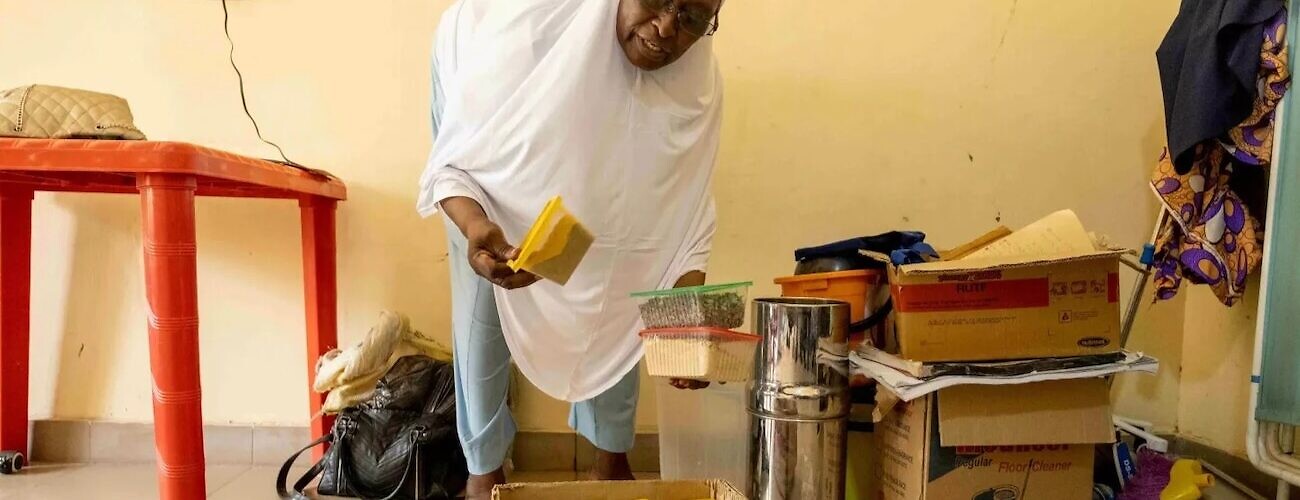
A health worker at a primary healthcare center on the outskirts of Maiduguri shows the food grains she distributes, 2025. UNICEF/Onafuwa.
The precipitous decline in funding for humanitarian assistance has made headlines around the world. In Nigeria, reports indicate that reductions in the delivery of food assistance, nutrition programming, and health services have already affected hundreds of thousands of people. According to the 2026 Nigeria Humanitarian Needs and Response Plan (HNRP), 7.3 million people are already in need of some form of assistance nationwide, including 5.9 million concentrated in three northeastern states. The World Food Programme (WFP) and UNICEF have warned in recent months that worse could follow. At the same time, Nigeria—along with many of its neighbors—has suffered for years from Islamist insurgencies and other sources of insecurity. Addressing humanitarian and economic challenges is critical to reducing this insecurity in Nigeria and the region.
Another layer of complication was added to the humanitarian response in Nigeria in March 2025 when the Inter-Agency Standing Committee (the UN-led global humanitarian coordination body) named Nigeria as one of eight countries designated for “humanitarian transition,” along with Cameroon, Colombia, Eritrea, Iraq, Libya, Pakistan, and Zimbabwe. This designation comes as part of the global Humanitarian Reset, a broader reform effort that, as the IASC acknowledges, comes as funding, access, and operational capacity are under “growing strain.” Of these eight contexts, Nigeria and Colombia stand out because of their combination of large-scale humanitarian needs, insurgencies, and potential for environmental shocks.
The 2026 HNRP characterized the humanitarian transition in Nigeria as “strengthening the role of the Government of Nigeria and civil society in coordinating and delivering humanitarian assistance, while gradually phasing out international support to humanitarian coordination where appropriate.” International support for humanitarian coordination is set to draw down over the course of 2026–2027 and cease by the end of 2027. During this window, the international community is undertaking a range of activities designed to support the government and Nigerian civil society with the additional burden imposed by the international drawdown.
In some ways, the choice of Nigeria as a transition country has a strong rationale. The humanitarian community has already been operating in Nigeria at large scale for more than 10 years. Nigeria has a significant natural resource base, the income from which could be used to finance humanitarian action. According to World Bank governance indicators, Nigeria’s government institutions are more effective than those in some other countries with large-scale humanitarian needs, such as the Democratic Republic of the Congo and Yemen, and are more on par with Zimbabwe and Kenya.
More broadly, there have long been calls for governments and national NGOs to play a stronger role in humanitarian action. The 2016 Grand Bargain and a large body of literature on localization emphasize support for the leadership, delivery, and capacity of local responders.
Nevertheless, the decision to include Nigeria among the transition countries carries considerable risk. As the 2026 HNRP also acknowledges, “crisis-level humanitarian needs are expected to be sustained—or even increase—for some time to come.”
The transition timeline also leaves little time to strengthen the financial, decision-making, and technical systems required for the government to take full responsibility for such weighty and large-scale functions. For Nigerians in need of humanitarian assistance—and for the country’s broader stability—it is vital that the transition be managed effectively.
The Nigerian experience will also offer lessons to the humanitarian community and governments around the world that may experience such a transition in the future. Continuous assessment will be required during and after the transition to ensure that real-time impressions, perceptions, and results are captured.
Can a Financially Driven Transition Kick-Start Effective National Ownership?
Drawdowns in international support for humanitarian coordination are usually triggered by an improvement in the humanitarian situation or an improvement in the capacity of national structures to meet residual humanitarian needs. The drawdown in Nigeria, by contrast, is taking place as humanitarian operations face a severe financial crunch, and the decision to draw down preceded planning for national structures to be sufficiently strengthened by the end of the transition.
Sustained and consistent political will from all sides will be required to ensure that the transition works and that the federal and state governments can shoulder the new level of responsibility for addressing lifesaving needs. On the government side, this political will must also survive the 2027 elections.
With global humanitarian funding severely reduced for the foreseeable future, the Nigerian transition will offer the broader humanitarian community insight into whether a financially motivated deadline can incentivize and accelerate national ownership without exacerbating the situation of those in need of lifesaving aid.
How Can the Shift in Responsibility Be Managed?
A fundamental element of the transition is managing the shift in responsibility for leading, coordinating, and financing humanitarian operations. While the government has always played a key role in Nigeria, the transition will significantly expand its responsibility for lifesaving assistance.
The government and the humanitarian community have already taken positive steps by undertaking joint transition planning. For its part, the Federal Ministry of Humanitarian Affairs and Poverty Reduction has also moved toward institutionalizing greater ownership, including by establishing the National Council on Humanitarian Affairs and Poverty Reduction and a One Humanitarian One Poverty Reduction System. The National Emergency Management Agency has also committed to strengthening its coordination and response role in light of the transition.
It is vital that all other relevant government organs—such as those for health, education, and housing—as well as state governments also play their part in taking ownership. In turn, federal and state legislatures must back their executive institutions with consistent and continuous funding for humanitarian action.
Developing the procedural and financial structures in the government is much more complicated than developing the equivalent structures within the humanitarian community. Globally, there will be lessons to draw from the mechanics of this shift in responsibility for leading and financing an operation of this scale, including the milestones and processes set by the Nigerian government and the humanitarian community to make that shift happen.
Can Development Approaches Strengthen Institutions That Help Deliver Lifesaving Assistance?
The extent of the new responsibilities taken on by the government and Nigerian NGOs means that implementing them will likely be an iterative learning process. Routinizing and enhancing the management of the financing, planning, and coordination of humanitarian support across Nigeria’s complex governance structures may take several years.
While the international community will support the strengthening of these structures during the humanitarian transition, international organizations must maintain technical and managerial assistance to government institutions and NGOs to support humanitarian planning, coordination, and financing beyond 2027. Such assistance will also be required in areas—such as the North West—with high levels of humanitarian need or vulnerability to shocks, and where structured international support for coordination has been largely absent.
Nigeria will be an important test of whether humanitarian and development actors—both Nigerian and international—can cooperate sufficiently to anchor these efforts to strengthen humanitarian institutions in longer-term national and international development planning and budgeting cycles, maintain relevant technical support capacities, and coordinate effectively to transition to more sustainable development assistance and durable solutions.
Can What Needs to Be Independent Stay Independent?
Partnership between the Nigerian government and Nigerian NGOs and civil society will be important to the successful planning, coordination, and delivery of lifesaving assistance in the future.
At the same time, the government is heavily involved in military and security operations in the areas where humanitarian need is greatest. Serious question marks have been raised over the conduct of Nigerian forces with regard to the protection of civilians. For its part, the government has leveled accusations that some humanitarian assistance has gone to insurgent groups.
While a close relationship between the government and NGOs is important, NGOs will therefore need to continue to assert their independence to enhance their chances of delivering aid in insecure areas and effectively monitor threats to civilians. The protection sector is already moving in this direction by ensuring the continuation of an independent architecture at the national and field level for data collection, monitoring, analysis, early warning, referrals, and delivery support. Similar efforts should be made to preserve space for coordinating independent humanitarian access so that NGOs can maintain strong information sharing, analysis, and discussion on operational responses. The international community should advocate for these mechanisms and continue to back them with technical and financial support.
How Can International Humanitarian Organizations Better Prepare for Implementing an Exit Strategy?
The drop in funding and the potential for further volatility in aid financing indicate that open-ended commitments to financing international humanitarian coordination systems may be a thing of the past. In future humanitarian crises around the world, the international humanitarian community will likely have to treat transitions as a more pressing reality and prepare for drawing down support for humanitarian coordination in a more structured way. This will allow more time—and hopefully financial resources—for systematically working with national counterparts to strengthen national institutions and organize a handover before resources start to dwindle.
The Nigerian case will be an important guide for judging realistic methods and time frames for institutional development, where to focus most time and resources from an early stage to prepare for an eventual exit, and how to cooperate with national partners to make it work—even before the deadline for ending international support to coordination has been set.
Peter Rice is an independent political and humanitarian affairs consultant who served as the UN’s strategic planner for the humanitarian transition in Nigeria from 2025 to 2026.