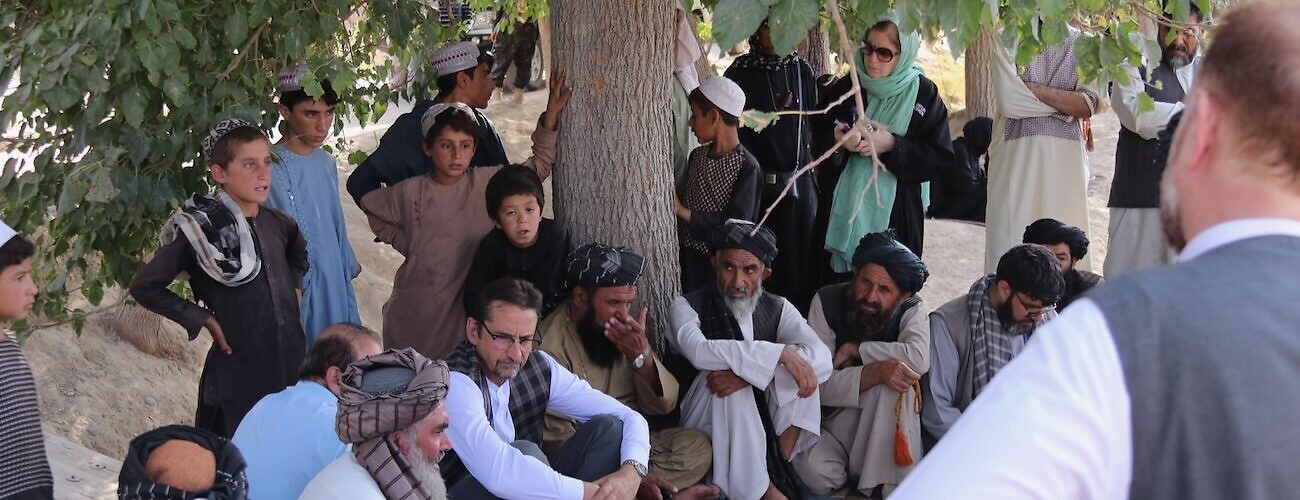
UNAMA Deputy Special Representative of the Secretary-General (DSRSG) Bruno Lemarquis meets with provincial authorities, farmers, communities, health workers, and humanitarian and development partners in Kandahar and Helmand, September 14, 2026. UNAMA.
A broad-based political process is an essential element of a stable peace for Afghanistan. The Security Council recognized this in its refocused mandate for the UN Assistance Mission in Afghanistan (UNAMA) in June 2026. This mandate tasks the mission with facilitating dialogue “between the relevant authorities in Afghanistan and other relevant stakeholders, including regional countries and the wider international community as well as civil society” aimed at promoting compliance with the country’s international obligations. It also mandates the mission to promote “inclusive, representative, participatory and responsive governance.” This mandate echoes the 2023 UN Security Council–commissioned Independent Assessment, which called for a “national political dialogue that would establish inclusive governance and ensure sustainable peace.”
But while advocates, political movements, and members of civil society that oppose Taliban rule agree on many key principles of governance and human rights, they lack a comprehensive mechanism for creating targeted and prioritized demands for their side of such an agreement. UNAMA, tasked with finding a political end state for Afghanistan’s conflict, is well placed to support structured consultations among non-Taliban Afghans to prepare for future negotiations. As a first step, achievable right now, UNAMA should work with Afghan and international experts to design a framework for these consultations.
Consolidating the Roadmaps and Connecting Them to All Afghans
Since the Taliban’s return to power in August 2021, numerous political actors—armed resistance movements, diaspora coalitions, civil society networks, and international bodies—have produced thoughtful roadmaps and other statements outlining Afghanistan’s political future, such as those produced through the Dialogue and Visioning Process. The Cambridge Afghanistan Series, coordinated by the Mosaic Global Foundation, has consolidated more than 20 of these documents into a “Comprehensive Composite Roadmap” intended to “design a viable future system while preparing for the realities of transition.” Participants in a September 2026 conference adopted the “Cambridge Declaration,” which sets out common principles of democratic cooperation and convergence. The declaration is a strong and viable starting point for national consultations that can lead to an agreed-upon negotiation platform.
In our own review of 11 post-2021 roadmaps and the 2001 Bonn Agreement, we focused on the key issues flagged by the 2023 Independent Assessment—inclusive governance and human rights—and found that convergence is real but shallow. The governance models proposed vary widely, with little agreement on structure. Commitment to human rights is similarly uneven: some documents name specific international instruments and propose real accountability mechanisms, while others gesture at rights in general terms without clarifying what a binding human rights commitment should include. If Afghan stakeholders do not achieve a working consensus, the Taliban could exploit these divisions in future negotiations through a “divide-and-conquer” strategy, endangering efforts to secure strong, enforceable concessions on governance or rights.
To strengthen consensus, these documents need a process to connect them to the lives of all Afghans. Afghanistan has consistently suffered from a representation gap. This gap was evident in the findings from the Asia Foundation’s authoritative “Survey of the Afghan People” from 2019 and 2021, including a three-wave panel tracking Afghan opinion in real time during the US–Taliban and intra-Afghan negotiations.[1] Never once did a majority of Afghans surveyed say they felt sufficiently represented, ranging from a high of 41% to a low of 34% across the three waves of the 2020–2021 panel survey.
This feeling was consequential. Compared to those who felt shut out, Afghans who felt represented were dramatically more likely to support negotiations (67% vs. 43%) and to believe reconciliation was possible (77% vs. 52%). As the negotiations progressed, belief that peace was achievable fell steadily from 54% to under 44%, tracking a parallel decline in feelings of being represented. When asked who should represent them at the negotiating table, Afghans overwhelmingly named domestic figures and institutions; no international actor was named by more than 11% of respondents.
Going back even further, major governance shifts in Afghanistan’s last five tumultuous decades have not derived from meaningful, popular consultations. Almost all previous regime changes in Afghanistan—including in 1973, 1978, 1992, 1996, and 2001—came about due to coups or invasions, and peace agreements that were dominated by the winning groups or elites. The one negotiated settlement in this period, the UN-brokered 1988 Geneva Accords, also lacked popular consultations. The period from the December 2001 Bonn Agreement to the January 2004 adoption of a new constitution was billed as national consensus building, but in reality the United States pushed to quickly roll out a government with the Taliban excluded, and it favored specific outcomes like a strong central government.
The ongoing “Doha Process” championed by UNAMA is the most recent example of this historical pattern of exclusion. Over the past three years, this process, which brings together the Taliban and international diplomats to discuss Afghanistan’s political future, has made no progress toward a political settlement that could underpin regional stability and Afghanistan’s reintegration into the international community. Its two working groups may include non-Taliban Afghan experts, but the groups are powerless to advance substantive reforms that will improve the lives of ordinary Afghans.
This consistent failure of Afghanistan’s negotiation processes to include the people they are meant to represent is correctable. What the Afghan people believe, whom they trust, and their support for peace itself depend in part on whether they feel included. Existing roadmaps cannot resolve this gap on their own, no matter how carefully synthesized, because the gap is not a drafting problem—it is a representation problem.
A Need for “Design Thinking” beyond Politics
To close the representation gap, UNAMA, within its existing budget and mandate, could support the design of a framework for future consultations among Afghans under current conditions, both inside and outside the country. A platform hammered out through such consultations would set out the principles and priorities for non-Taliban negotiators seeking a sustainable and just peace. Non-Taliban actors cannot credibly negotiate as one side until they have reached agreement among themselves, and this agreement is thus a necessary precursor to any internationally supported talks with the Taliban.
The process facilitated by UNAMA could be guided by “design thinking”—a process of understanding the problem, exploring a range of solutions, testing and iterating on approaches, and finally implementing an approach. In this case, design thinking could be based on several principles.
Leveraging UNAMA’s Impartiality and Resources: Despite some misgivings among Afghans on all sides about the United Nations, there are practical and political reasons to keep the UN behind this project. UNAMA is the only entity with a budget large and continuous enough to design and implement these consultations. Having UN backing would keep the process from being perceived as belonging to a specific regional country or “the West.” Facilitating multi-stakeholder dialogue is also a mandated task that the mission has neglected.
This would not require a change in mandate but would require the Security Council to put its full weight into giving UNAMA the political clout it will need to proceed, given likely Taliban opposition. Through statements and consultations, the Council can point to its interest in finding an end state to the current multilayered crisis through a political settlement, citing the findings of the Independent Assessment. The Council should also make it clear to the new special representative of the secretary-general that a benchmarked process toward a political resolution should include this design process as a priority. UNAMA could fund this work appropriately from within its current budget. Although the mission’s 2026 budget and staffing were cut as part of a general effort to trim UN expenditures, it retains 64 posts in its Office of the Deputy SRSG for Political Affairs. A design process could be resourced by reprioritizing within this capacity.
Building from Afghanistan’s Culture: Unlike in the past, this process of consultation can and should be protected from international deadlines, agendas, and pressure. It should build on relevant Afghan peacebuilding concepts such as deliberative decision making, locally generated policy solutions, and options beyond “winner-take-all” end states. An important resource is the Asia Foundation’s 2004–2021 annual “Survey of the Afghan People,” the widest-reaching and longest-duration effort in Afghanistan’s history to find out what citizens thought about economic, social, and political issues. Another resource is the “Strategizing a Seat at the Table Initiative,” which focuses on bringing Afghan women into spaces and processes to discuss the future of the country.
Examining the Constraints: Consultations will confront significant logistical hurdles. The population in Afghanistan is under repressive control, faces dire economic conditions, and, in the case of Afghan women, has a near-total inability to meet and express opinions freely. Diaspora populations in Pakistan, Iran, Türkiye, Australia, Europe, and North America live with varying degrees of liberty, security, and economic stability. No single physical gathering could include everyone, particularly those lacking funds and travel documents, while limited access to reliable Internet and time zone differences would make even virtual meetings difficult.
A consultation would also face social and historical hurdles. It is imperative to make women’s voices count early and deeply. Many previous roadmap and dialogue processes have excluded key groups of “nonpolitical” people, including rural and conservative non-Taliban Afghans, small-business owners, farmers, teachers, doctors, traditional leaders, and others. Their voices are crucial as well.
A consultation process could use creative ways to involve this diverse range of Afghans. Inputs could be solicited through phone-in radio shows, which are already a forum for Afghans to discuss sensitive topics under Taliban rule, and on social media, where Afghans already engage in vigorous debate. Parts of the process could also use satellite TV, which reaches around 19 million people, and the effort could draw on powerful existing networks of families, friends, colleagues, and movements.
A consultation would also have to overcome the society-wide trust deficits that emerged following the demise of the Afghan Republic. It should not become a new forum for personal competition or bids for access to power. One option would be to clarify that those leading the process would be chosen for their mediation and technical experience and asked to recuse themselves from prospective political roles.
Learning from International Experiences: Drawing on past peace processes and social initiatives around the world, including in Central America, the Philippines, South Africa, and many other conflict zones, could shed light on different approaches to structured consultations. Several examples contain design elements worth considering, including ways to increase women’s participation, reach populations under a dictatorship, use technology to gather views on policies and actions, and collaboratively draft, share and fact-check policy ideas. International experts in peacemaking, social organizing, and digital outreach should participate in support of Afghan leaders, scholars, and communications experts.
Conclusion
Without a benchmarked process toward a true political settlement among Afghans, UNAMA will continue to carry out its functions into the foreseeable future, repeating past mistakes but with dwindling resources and increasing risk of normalizing a human rights catastrophe. There is no regional stability, or end to the need for UNAMA, without a durable political solution—and no durable solution without asking the people what they want. Security Council support can be tied to the bigger issues of international stability and UN efficiency that member states publicly espouse. During regional and UN meetings, Russia and China have flagged the regional threat caused by the Taliban hosting terrorist groups and failing to meet the needs of the Afghan people, while the United States has called for streamlining and cost-cutting across political missions.
The task as outlined is difficult but achievable, and urgently needed. A genuine, broad-based consultation on governance and human rights is a necessary step toward addressing the representation gap that has undermined previous peace efforts. It could also provide an eventual negotiating platform with the durable legitimacy that elite consensus alone has not been able to produce (and that the Taliban completely lack). The Mosaic Global Foundation has framed it as the need for a “paradigmatic shift” away from the drafting of a utopian blueprint toward a “politics of representation, participation, pluralism, and rectifiability.” The world needs to finally move the conversation to those who are qualified to speak for themselves.
[1] The Survey of the Afghan People was the longest-running barometer of Afghan public opinion, gathering views from more than 148,000 Afghans over more than 15 years (2004–2021) on governance, reconciliation, and related topics. The two surveys cited here had large, nationally representative samples: 17,812 respondents in 2019 (margin of error ±1.2%) and 18,362 in 2021 (margin of error ±1.1%). The survey was discontinued after the 2021 Taliban takeover. The 2020–2021 Flash Survey panel draws on smaller samples and different methodologies than the Survey of the Afghan People and is presented here as directionally consistent rather than directly comparable.
Annie Pforzheimer served as the Deputy Chief of Mission at the US Embassy in Kabul and is currently an adjunct professor of international relations at Pace University and the City University of New York. Mursal Kabir holds an MPA from Syracuse University’s Maxwell School and works as a data analyst in New York City. They are members of the Global Friends of Afghanistan, a nonprofit organization dedicated to educating international audiences about Afghanistan.