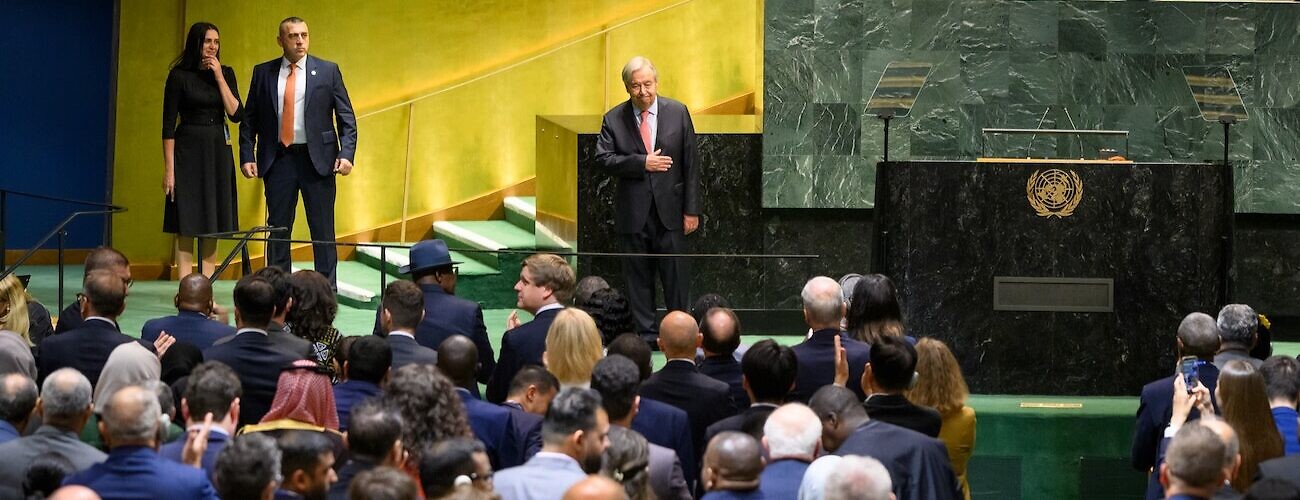
Secretary-General António Guterres receives a standing ovation after his address to the general debate of the General Assembly’s eighty-first session, September 22, 2026. UN Photo/Loey Felipe.
Every September, leaders from around the globe descend on New York to address the UN General Assembly. This year’s debate, held from September 22nd to 28th, featured speeches from 191 of the 193 UN member states (all but Afghanistan and Myanmar), as well as both observer states (the Holy See and Palestine) and the European Union. Recurring themes across these 194 speeches included artificial intelligence (AI), the state of multilateralism, and the impacts of the wars in Ukraine and the Middle East.
Where was climate in the debate? Despite worries that other recent crises have pushed climate change to the edge of the multilateral agenda, climate change was discussed by the vast majority of those who spoke. The specific topics they touched on, revealed by a comprehensive analysis of every General Debate intervention, show which elements of the challenge remain at the top of the political agenda.[1]
Climate Remains on the Agenda
Of the 194 speakers, 167 (86%) made at least a minor reference to climate change, characterizing it as a serious problem or supporting stronger climate action. This total is similar to or slightly larger than last year, and it dwarfs the six who expressed some level of skepticism about climate action. A total of 51 speakers referenced the energy transition, 48 mentioned sustainable development, green growth, or similar topics, and the same number referenced clean energy sources.
This is well above the 20 speakers who described or supported fossil fuel projects. Notably, five of the six speakers expressing climate skepticism were quite measured, generally stressing that due regard should be given to other priorities in the context of the energy transition. Only US President Donald Trump spent a significant amount of time attacking the scientific and political consensus on climate change. Moreover, of the 20 who discussed fossil fuels, 13 also supported clean energy or the energy transition and 19 touched on climate, showing a balanced approach.
While it is easy to discount the speeches made by world leaders as short on substance, the fact that the overwhelming majority still talked about climate change when given the opportunity to flag their priorities shows that the topic remains important.
Energy Security, Climate Impacts, and Finance Top the List of Priorities
A total of 109 speakers mentioned energy access or energy security, including the impacts of the current wars in Ukraine, Gaza, and Iran.[2] Further, 107 speakers mentioned topics related to adverse impacts of climate change, including discussion of vulnerabilities, loss and damage, heat, sea level rise, and climate-related natural disasters. Even among the 25 speakers who did not mention climate change, 12 discussed the related issue of energy security. This may speak to the political salience of the concrete, negative impacts of energy and climate crises.
Developing countries face disproportionate adverse impacts even though their limited total historical emissions mean that they are not primarily responsible for global warming. Moreover, they must address climate change while pursuing development and poverty alleviation. For these reasons, the general debate featured regular mentions of climate finance and financial system reform (66 mentions, including 62 from developing countries); justice, including a just transition (59, including 56 from developing countries); resilience (54, including 52 from developing countries); adaptation (39, including 35 from developing countries); and adaptation finance (20, including 19 from developing countries).
Several other topics were notable for the high—or low—number of mentions. A total of 39 speakers talked about critical minerals (most of them producers), and 20 supported the use of the Multidimensional Vulnerability Index to gauge the capacities and needs of developing countries. Meanwhile, 17 cited climate science, 15 cited the intersection of climate, peace, and security (not including energy security), and 12 referred to the recent advisory opinion of the International Court of Justice on the Obligations of States in respect of Climate Change. Finally, 10 mentioned net-zero targets or carbon neutrality, five mentioned climate migration, and four mentioned methane. Efficiency or demand reduction, the proposed Fossil Fuel Non-Proliferation Treaty, carbon capture, and international transport each elicited only a single reference, indicating limited focus on their role in climate policy in the years ahead.
Leadership Is Lacking Where It Matters Most
As in so many other areas, several of the five permanent members of the UN Security Council (the P5) are out of step with the broader membership. Trump continued his familiar refrain of opposing climate regulations. Russia made only one indirect reference to climate change, and neither the United Kingdom nor China made the issue a central part of their statements. Given their position within the UN system, many expect the P5 to be active leaders in climate diplomacy, but at least in 2026, this leadership has not materialized. The one exception was France, with President Emmanuel Macron discussing climate at greater length.
Beyond the UN’s membership, outgoing Secretary-General António Guterres has made climate one of his signature issues, mentioning the word nine times in his final speech to the General Assembly. This legacy was reinforced by the approximately 65 speakers who hailed his leadership on a variety of issues, including climate. The question is now whether his successor will place equal importance on the issue. Most of the current candidates have addressed climate change, but their vision statements generally prioritize other issues.
As the world faces the prospect of breaching the Paris Agreement’s 1.5°C goal, and as armed conflicts disrupt energy flows, climate change is becoming an ever more urgent challenge. In the 2026 general debate, it still attracted significant attention from world leaders. Only time will tell whether this will continue in the years to come or whether other issues will overshadow it.
[1] This analysis is based on the transcripts provided by the United Nations, which are created with automatic speech recognition, but the coding and analysis were done manually with no use of AI. Unless otherwise noted, references to a particular topic are aligned with the scientific and political consensus that climate change is an urgent problem necessitating action. Instances of speakers showing skepticism about climate action or pessimism about a particular policy or technology are coded separately. Throughout this article, “mentions” and “references” refer to the number of distinct speakers who touched on a topic at least once.
[2] Mention of energy security/access alone was not considered as constituting a reference to climate change and was not included in this figure.