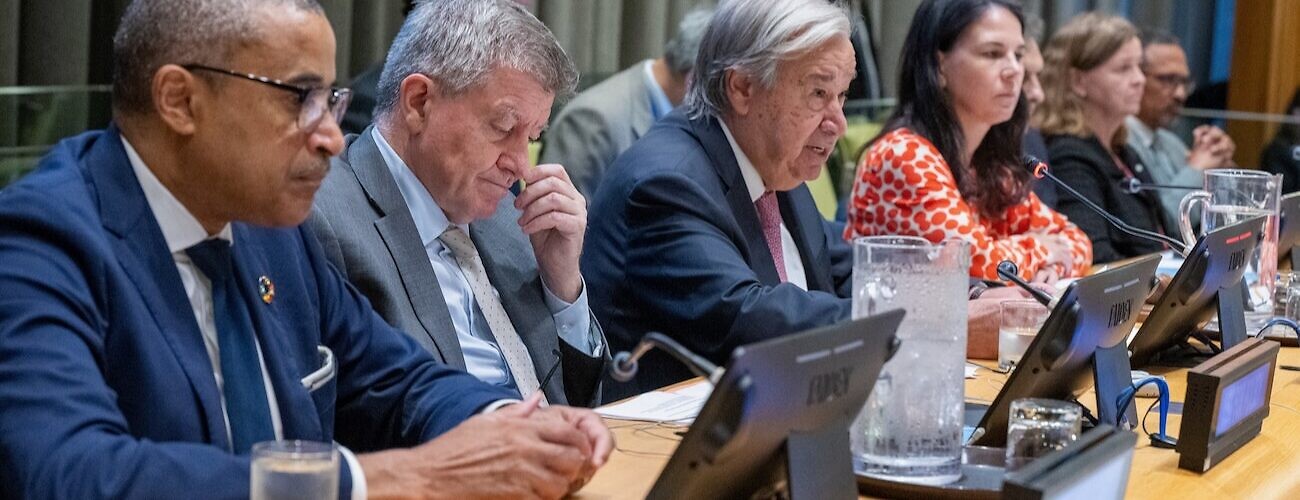
Secretary-General António Guterres addresses the informal meeting of the plenary to hear a briefing by the Secretary-General on the UN80 Initiative, September 3, 2026. UN Photo/Eskinder Debebe.
After 18 months of internal consultations and intergovernmental deliberations, it seems as if the only tangible outcome of the structural realignment track of the UN80 initiative—Workstream 3—will be the consolidation of the UN Institute for Training and Research (UNITAR) and the UN System Staff College (UNSSC) into the UN Institute for Capability and Learning Innovation (UNICLI), which the General Assembly approved on September 3rd.
When Secretary-General António Guterres launched the UN80 initiative, he announced to member states that the effort would yield proposals on “deeper, more structural changes and programme realignment in the UN system.” Expectations were further raised shortly afterward when an internal compilation of proposals was leaked containing sweeping mergers of UN entities and organizations across the areas of peace and security, humanitarian affairs, development, and human rights.
Since then, however, the effort has been stalled by acrimonious turf wars that have spilled into intergovernmental forums. During Guterres’s informal UN80 briefing to the General Assembly on September 3, the G77 and China took note with appreciation that the executive boards were “not yet in a position at this time to make a recommendation of support on the proposed mergers between UNDP and UNOPS and UNFPA and UN Women” and welcomed exploration of “alternative options to enhance coordination and efficiency, including through greater operational alignment and coordination.” In short, the other sets of proposals that have been presented are unlikely to move forward, given that no action will take place before the end of Guterres’s term.
What Went Wrong?
The fundamental problem with Workstream 3 is that it put the cart before the horse. The exercise began with the presumption of the need for mergers before a case had been made for them, and it failed to take into account the member state and staff constituencies with an interest in ensuring the survival of specific entities. The merger proposals in the leaked memo were based largely on a superficial understanding of the mandates and activities of the entities and organizations in question and without consideration for politics or process. This careless approach provided fodder for opponents of reform to build their case and ensure that the proposals, when finally presented, would receive a hostile reception.
Another issue is that structural reform of the UN bureaucracy is most likely during the honeymoon period at the start of a secretary-general’s term, when the secretary-general enjoys the strongest support from member states and has the greatest ability to make strategic decisions on senior appointments. Major reform is highly unlikely now, with a secretary-general in the final year of a lame-duck term and when staff morale is at a nadir.
Why Was It Proposed in the First Place?
What should we make of the fact that Workstream 3 was included in UN80 in the first place? The secretary-general had already undertaken a reform initiative during his first term that was supposed to have solved the identified problems. That’s why his “Our Common Agenda,” which framed the agenda for his second term, pointedly placed responsibility for the declining effectiveness of the multilateral system on member states rather than on the UN bureaucracy. But Workstream 3 did not emerge out of an honest reflection on the shortcomings of his earlier reforms. Indeed, the fact that the secretary-general sought reform proposals from his senior managers—individuals with strong incentives to protect their respective fiefdoms—suggests that he launched this workstream with no vision or strategy.
But it is a mistake to see UN80 as a serious reform agenda. After all, the impactful elements of Workstreams 1 and 2—efficiency and mandates—could have been done under the secretary-general’s own authority without creating heavy intergovernmental processes. It makes much more sense to understand UN80 as an attempt by the secretary-general to signal a commitment to cost-cutting and reform to the Trump administration early in 2025. The hope was that the launch of UN80 would be sufficient to spare the UN the brunt of potential budget cuts. The inclusion of a structural reform track makes sense in this context; structural reform is highly visible, and its inclusion would appear to strengthen this commitment to reform.
How Should We Approach Structural Reform?
Just because many of the restructuring proposals under UN80 were weak doesn’t mean that structural reforms are unnecessary. We’re in a geopolitical transition period, and the logic underpinning much of the UN’s current structure may no longer make sense in an environment of renewed geopolitical contestation. After all, the logic of the current Secretariat structure still follows the outlines of the major reorganization undertaken by Boutros Boutros-Ghali in 1992 to better reflect the unipolar moment. The organization he devised replaced an earlier Cold War–era structure, largely unrecognizable today, premised on the logic of balancing Western, Soviet, and non-aligned interests.
Just because there is strong opposition from both staff and member states to the UN80 proposals doesn’t mean that any attempt at structural reform is doomed. There are many different ways an organization can be structured to implement any given set of mandates. Structural reform should begin by looking not at structures but at the overall effectiveness of the organization in individual thematic areas and the activities of the associated functions, regardless of where they are organizationally located.
There are many reasons why the UN might fall short in implementation, and not all are structural in nature. Coordination problems are not always best solved through mergers or the creation of new coordination structures. And even when several entities appear to overlap in thematic focus, the nature of their activities can be very different (e.g., political engagement vs. operations and delivery on the ground).
But there are situations in which structures sit at the root of the problem. Structures can create incentives or path dependencies that drive adverse outcomes. Also, the original justification for why a particular structure looks the way it does may no longer be valid because of changes in the issue or in the politics around that issue. In such situations, a case has to be built around the specific shortcomings in mandate implementation, why structures are at the heart of those shortcomings, and how a change in structures can help resolve them. Internal organizational dynamics and interests also need to be accounted for, and reform proposals need to be developed by a mix of profiles, including individuals without a personal stake in maintaining existing arrangements such as former officials, external experts, and individuals with experience at the coalface of program delivery.
All of this needs to be pursued in a manner that is sensitive to intergovernmental politics. All existing entities have member-state constituencies, including champions, beneficiaries, donors, and the countries whose nationals hold departmental leadership positions. This is why specific structural reforms often need to be presented as part of a broader “grand bargain” package with enough hooks that no individual member state or regional group feels targeted or sees itself as being worse-off post-reform, in relative terms, than pre-reform. Only by mitigating opportunities for such parochial objections can the merits of a proposal be considered.
This will take time to do properly. Once a secretary-general enters office and becomes responsible for steering a complex international bureaucracy charged with solving all of the world’s problems, there will be little time for analysis and reflection. This is one reason why the transition period is so crucial for reform agendas.
Lessons for the Next Secretary-General
In many ways, UN80 presents a cautionary tale of what not to do if you want structural reform at the UN. The proposals came at the end of the secretary-general’s term, when his political capital was lowest. The exercise was premised on consolidation even before a case had been made, providing ample opportunity for opposition to harden regardless of its merits. And responsibility for generating proposals was pushed to entities with a vested interest in maintaining the status quo, all but guaranteeing the lowest level of ambition in structural reform proposals.
More broadly, the structure of the overall UN80 initiative was not conducive to reform. The three tracks of UN80—efficiency, mandates, and structures—broadly corresponded to the how, the what, and the who of UN activities. A thoughtful approach to reform needs to look at all of these aspects together, but in the UN80 initiative, each of these workstreams was pursued in isolation, by different individuals, at different speeds, and at different levels of granularity.
Again, this all makes sense if the UN80 initiative was meant to be a signaling exercise rather than a reform agenda—a panicked and ultimately unsuccessful attempt to preempt cuts from a US administration uniquely hostile to the UN. If the next secretary-general is serious about reform, they should make sure not to follow the UN80 playbook.
This article was originally published in Eugene Chen’s weekly column on Substack, “Blue Helmets, Red Tape.” It has been edited from the original version.