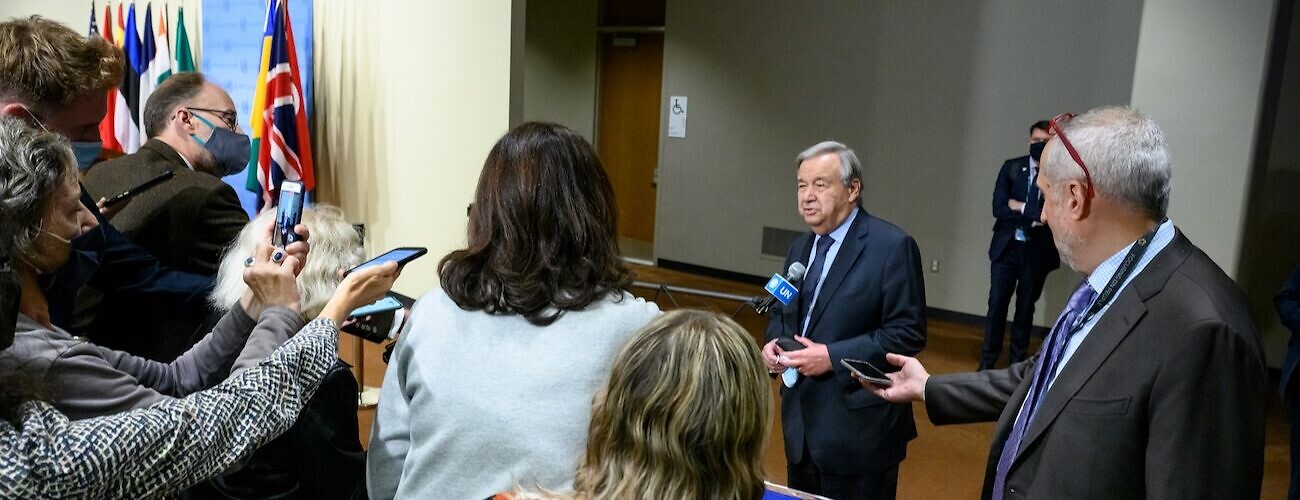
Secretary-General António Guterres briefs reporters after the Security Council meeting on peace and security in Africa, October 6, 2021, UN Photo/Loey Felipe.
The candidates competing to lead the United Nations have promised an organization that is more present and active on the ground. But governments have been expelling UN officials with increasing frequency and almost no consequence. What can the new secretary-general do? Until now, the organization’s response has settled into a formula: express confidence in the expelled official, then comply with the decision. The incoming secretary-general has a chance, in the first months of the mandate, to do something about this and send a message to staff in the field that the 38th floor has their back.
The Legal Basis for Persona Non Grata
In international law, the declaration of persona non grata is a tool states use to expel diplomats. It is grounded in customary practice and, for accredited diplomatic missions, codified in the Vienna Convention on Diplomatic Relations, which grants states the unqualified right to expel any member of another state’s diplomatic personnel. UN officials fall outside that regime. Their status comes instead from the 1946 Convention on the Privileges and Immunities of the United Nations, known as the General Convention, which implements Article 105 of the Charter.
Section 18 of the 1946 Convention covers UN officials generally, granting them immunity from legal process for words spoken or written and acts performed in their official capacity and exempting them, together with their spouses and dependent relatives, from immigration restrictions and alien registration. Section 19 applies specifically to the secretary-general and assistant secretaries-general, according them the privileges and immunities of diplomatic envoys. Neither provision grants host states the power to expel UN officials on the same terms as the Vienna Convention allows them to expel diplomats.
The UN’s position that its officials are exempt from expulsion goes beyond the 1946 Convention. Articles 100 and 101 of the UN Charter establish that UN staff answer only to the organization, that member states undertake to respect the exclusively international character of their responsibilities and not to seek to influence them, and that staff are appointed by the secretary-general under regulations established by the General Assembly. The organization’s position, restated each time an official is thrown out, is that only the secretary-general can decide to withdraw UN staff. Therefore, a state that expels a UN official, whatever their rank, is interfering in the internal affairs of an international organization in ways the Charter does not permit.
How Expulsions Work in Practice
In practice, these legal mechanisms protecting UN officials cannot be enforced. States hold the sovereign power to decide who may enter and remain on their territory, whether by formal declaration or simply by canceling a visa or declining to renew one. When they use this power against UN officials, those officials are either barred from entry or forced to leave.
The practice of expelling UN officials takes two forms. In the first, a state targets an official based at headquarters. This is the older of the two: after Trygve Lie pressed the Security Council to act on North Korea’s invasion of the South in 1950, the Soviet Union stopped recognizing him as secretary-general and cut off contact. Recent declarations against the secretary-general and the high commissioner for human rights also belong to this category. In these cases, the official continues with their work from headquarters. In the second form, an official is expelled from the country where they serve, disrupting the UN’s work and the individual’s life.
This article is about the second kind of case. The pressure on special representatives, resident and humanitarian coordinators, and other field staff has risen over the last several decades—and even more so recently—particularly for those with reporting and advocacy mandates.
The earliest such case took place in the Congo. In January 1961, Congolese leaders demanded the recall of the head of the UN mission, Rajeshwar Dayal, after he refused to use UN troops against their political rivals, and repeated the demand in a cable to the Security Council on February 1st. Backed by Western powers that feared Dayal’s stance favored pro-Soviet factions, the government refused to cooperate with the UN. Dag Hammarskjöld rejected the demand and reaffirmed his confidence in Dayal, but the Congolese authorities made his return impossible. He resigned on May 22, 1961.
More recently, the late Nicholas Haysom was expelled from Somalia in 2019 after the mission questioned the legal basis for arresting a political candidate. Ethiopia expelled seven senior UN officials in 2021 after they warned that a government blockade on Tigray was driving hundreds of thousands into a man-made famine. In Burkina Faso, the junta expelled resident coordinator Barbara Manzi in 2022 for the UN’s decision to evacuate nonessential staff. Then it banished her successor, Carol Flore-Smereczniak, in 2025 for exposing military and jihadist abuses against children.
Meanwhile, in February 2023, Mali’s military junta expelled the human rights chief of the UN mission in Mali (MINUSMA), Guillaume Ngefa-Atondoko Andali, for facilitating UN briefings that criticized the military and its Russian Wagner Group partners. Israel pushed out humanitarian coordinator Lynn Hastings in late 2023 by denying her visa over alleged bias. Finally, Sudan expelled Special Representative Volker Perthes in 2023, blaming his diplomacy for fueling the civil war.
This is not an exhaustive list. Furthermore, these cases involve senior officials and reflect only what has been published in the press. Many cases involving more junior staff are not made public but are also deeply disruptive to UN operations and to the staff’s lives. The incoming secretary-general will almost certainly face another expulsion, possibly within months of taking office. The choice will be whether to treat it as a bilateral irritant to be smoothed over or as a recurring problem to confront.
What the Next Secretary-General Could Do
If the new secretary-general decides to take this issue seriously, they could take several steps acting on their own authority. First, they could ensure a record of all cases is compiled and presented publicly. The UN already tracks one form of state interference with its staff: through the Department of Safety and Security it counts and reports each year cases of personnel detained or arrested by member states. It has not done the same for expulsions, though a persona non grata declaration obstructs the organization’s work as well. Expulsions are already documented through some secretary-general reports on certain countries, but there is no comprehensive list of expelled staff.
A record would also show how large the problem is. The public expulsion of a resident coordinator or special representative draws a statement from the spokesperson and a few days of attention; the expulsion of a more junior official draws no attention, and governments know the secretary-general will not personally address every instance of a mid-level or junior officer being forced to leave. It is not known how often this happens at the working level. A record of every expulsion, whatever the rank of the person removed, would expose such behavior by states.
Second, the secretary-general could step up their naming and shaming. Successive secretaries-general have expressed confidence in officials that host states have thrown out, but this formulation has been worn by repetition. A secretary-general could instead set a standard at the outset: that the expulsion of any official despite proper performance of their duties will be publicly named as a breach of the Charter and raised directly with the government concerned and in public. The difference between quietly regretting an expulsion through a spokesperson and rejecting it strongly and publicly, as declared policy, may not change the decision making of an expelling country but will at least raise the cost of doing so.
Third, they could change the UN’s approach to dealing with the expelled official. The organization could state in writing, through updated human resources policy, that expulsion by a host state in cases where the secretary-general has publicly affirmed the official’s conduct will not count against that official’s career. Instead, the expelled official should be prioritized for reassignment, signaling that standing firm is recognized and rewarded. Haysom’s path after Somalia shows the system can do this when it wants to: he went on to hold a series of senior posts, ending as head of the UN mission in South Sudan. But the system has never made this into official policy.
A government determined to remove an inconvenient UN official will do so regardless of any of these measures. States that have expelled multiple consecutive resident coordinators are not going to be stopped by a register or a strongly worded statement. These measures would work at the margin: they would raise the cost of acting, extend some protection to staff, and indicate to member states that the organization treats its own legal position seriously.
The damage from these expulsions lies not only in the personal harm done to the UN staff who are expelled; it lies mostly in the chilling effect they have on other staff. The secretary-general should act to reassure staff in the field facing difficult decisions that they should keep doing their jobs. This is not an argument for recklessness. Field staff still need to master the art of diplomacy, building relationships with difficult governments and judging carefully when to speak and when to hold back. At the same time, what they need from the organization is to know that if they are expelled, they will not be left to face the consequences alone.
The difficulty is the timing. Put in place at the opening of a mandate, before any particular case has come up, these measures would be seen as a statement of how the organization intends to operate. But if they are introduced after the first expulsion of a new tenure, they will be seen as a reaction to whichever government has just acted. Early action would signal to staff and member states that a new chapter prioritizing staff on the front lines has begun.