A view of visitors at the peace and security exhibit during a guided tour of the UN headquarters, July 25, 2024. UN Photo/Loey Felipe.
The 81st session of the UN General Assembly is taking place under the theme “Restoring Trust, Managing Transformation.” Opening the session on September 8th, the incoming president of the General Assembly, Khalilur Rahman, cited a “widening trust deficit” that is “testing confidence in international institutions and collective action.”
Concerns about trust in the UN are not new. At his swearing-in ceremony in 2016, António Guterres concluded his speech saying that his “contribution to the United Nations will be aimed at inspiring… trust.” Ten years later, the candidates to succeed him are again pledging to rebuild trust. Across their vision statements and interactive dialogues with the UN General Assembly, the eight current secretary-general candidates mentioned “trust,” “credibility,” “confidence,” and “legitimacy” nearly 400 times, including more than 100 times specifically in reference to the UN or the multilateral system.
But whose trust are they referring to? In many cases it seems to be the trust of member states. This makes sense; the UN needs to secure the trust of member states to function effectively and overcome its current financial crisis. As Ivonne A-Baki put it succinctly at her interactive dialogue, “When we have trust, money will flow.”
Yet there is also another kind of trust: the trust of the public. Rebeca Grynspan drew this distinction in her interactive dialogue, calling for a “double-fold strategy” to “rebuild trust in this organization” not only with the membership but also with “the populations and the global citizenship.” This source of trust may be less directly relevant to the UN’s immediate financial crisis, but it is critical to the organization’s longer-term legitimacy.
Taking Stock of Public Perceptions of the UN
Has the global public lost trust in the UN? The short answer is no, but there are mixed signals. There is also a wealth of new data to draw on, with two new cross-national surveys on public perceptions of the UN released within the past week (a 34-country survey by the Rockefeller Foundation and Focaldata and a 20-country survey by the UN Foundation).
Overall, these and other recent cross-national surveys show that views of the UN remain largely positive on a global scale. Yet there is variation over time, between countries, and within countries.
Over time, trust in the UN has trended downward, but only slightly—and there may be signs of a rebound. Until recently, trust in the UN had gradually eroded over the course of several decades, but there was little evidence of a major, widespread drop. Beginning around 2022, however, surveys began to register a clearer deterioration in public opinion.
Over the past year, surveys have diverged. After registering an uptick in favorable views of the UN in 2025, Pew’s annual Global Attitudes Survey showed an overall drop in 2026. While favorable views still predominated (a median of 55% favorable to 37% unfavorable across the 37 countries surveyed), 10 countries registered a statistically significant drop in favorability since the previous year, and only one registered an increase.
A different picture emerges from the new 2026 survey by the Rockefeller Foundation and Focaldata, which found an overall increase in trust in the UN since the inaugural survey in 2025 (from 58% to 62% across the 34 countries surveyed). Various factors could account for this divergence, including question wording (favorability vs. trust), survey methodology (telephone and face-to-face vs. online panel), timing (February–May vs. July–August), or the selection of countries.
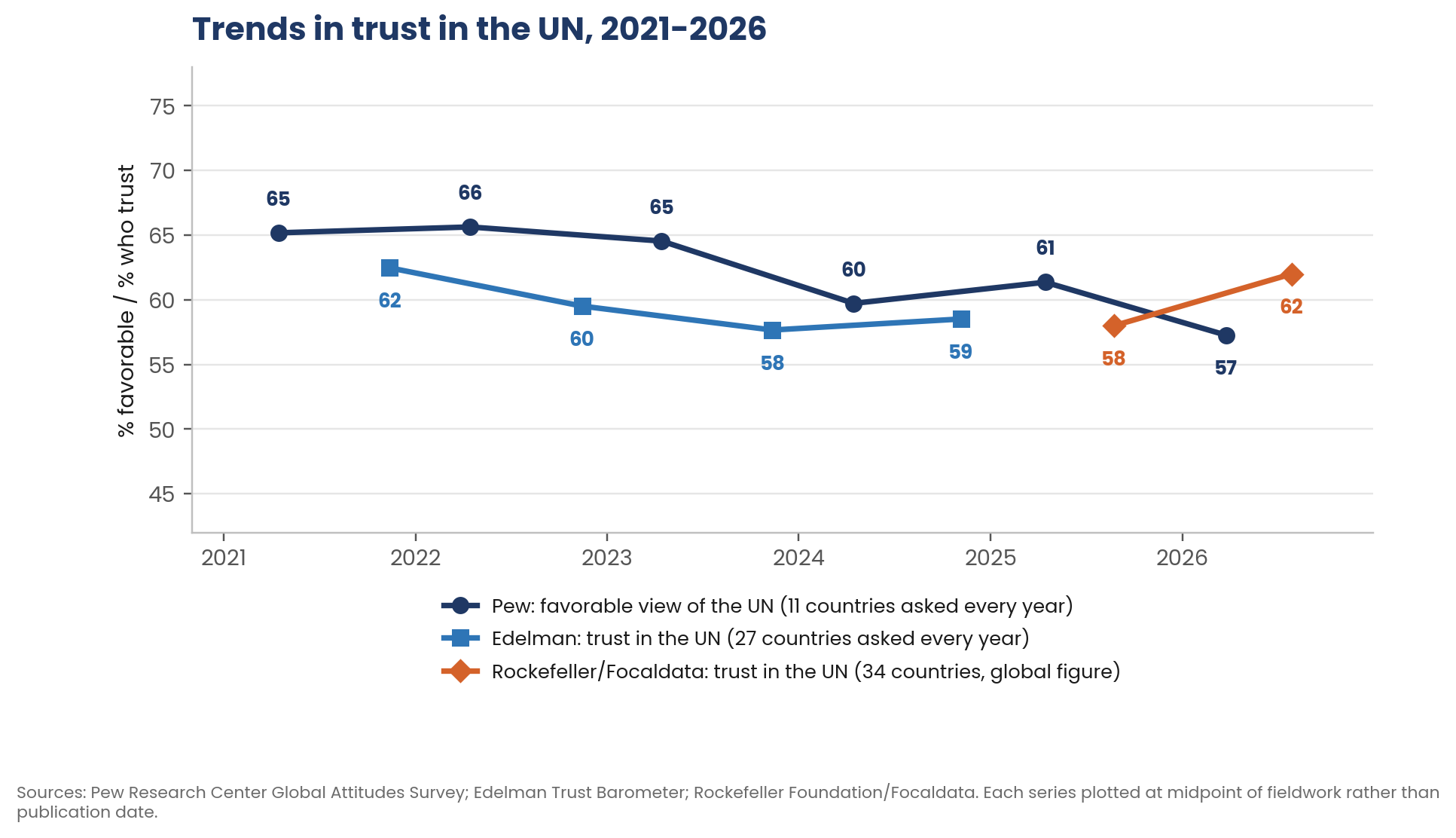
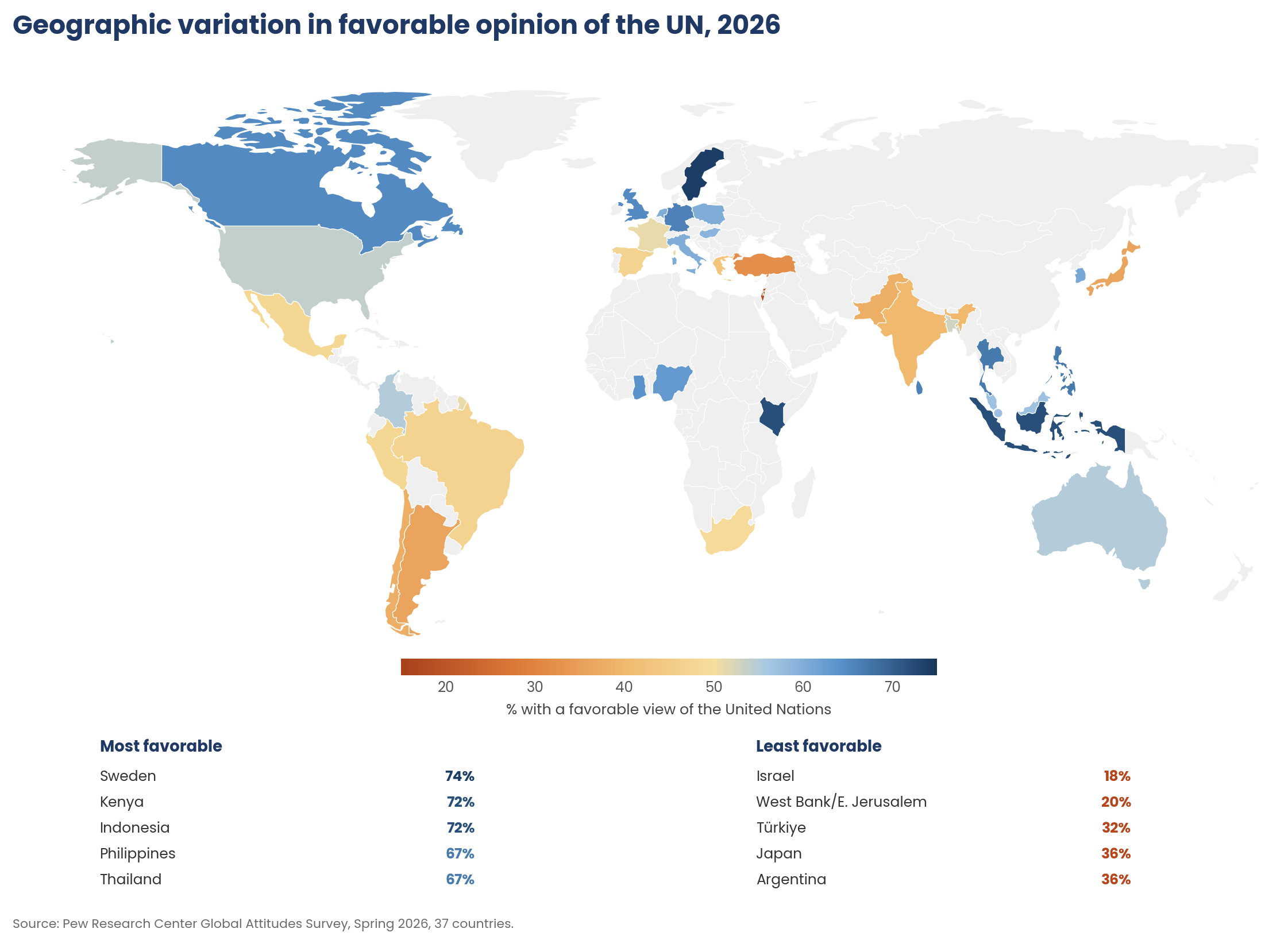
There is also significant variation in public perceptions of the UN between countries. Surveys consistently show that perceptions are more positive in Northern Europe, Southeast Asia, and parts of sub-Saharan Africa and more negative in much of the Middle East and North Africa and Latin America. More broadly, perceptions of the UN are significantly more positive in developing than wealthier countries (with 57% vs. 46% expressing comfort with the UN playing a leading role in world affairs) and in the Global South than the Global North (with 65% vs. 44% trusting the UN).
Within countries, the UN’s favorability varies depending on factors such as age and ideology. Young adults tend to be more favorable toward the UN than older adults. Political ideology is also a strong driver of perceptions of the UN, with higher skepticism among populist voters, especially on the far right. Partisan differences are particularly strong in the US, where views of the UN have become increasingly polarized between Democrats and Republicans.
The Gap between Demand and Performance
These differences in perceptions of the UN are driven by both individual factors within the public (e.g., demographic traits and ideological disposition) and institutional factors related to the UN itself. While individual factors are outside the UN’s control, the UN can respond to institutional factors.
Scholars have generally focused on two types of institutional factors: procedures and performance. Procedures refer to how the UN operates. For example, there is evidence that the public sees global governance institutions as more legitimate when they include nonstate actors in decision making. Conversely, there is evidence that the public sees international organizations as less legitimate if powerful states have institutionalized influence such as veto power.
Performance refers to how the UN actually delivers—and that is what I focus on here. There is strong evidence that the public legitimacy of international organizations is tied to their capacity to deliver. It is therefore unsurprising that there is broad public support for the UN to do more, not less. A 2026 analysis by Global Nation found that nearly two-thirds of respondents believed “international bodies should have the right to enforce solutions” to certain problems—a marked increase from the prior year (64%, up from 57%, across the 31 countries surveyed). Only 22% of respondents to the 2026 UN Foundation survey said they distrusted the UN because it interfered too much in the affairs of individual countries—far lower than the 56% who were dissatisfied that the UN cannot enforce international law or protect human rights.
This speaks to the gap between what people want the UN to deliver and how they rate its performance. In a 2026 UN Foundation survey, 84% said they believe the UN remains necessary—including 32% who believe it is “more necessary than ever”—but more than half added the caveat that it is also struggling to deliver results. Similarly, in the US, only 32% of respondents in a 2025 Gallup survey said the UN was doing a good job, but 60% said the UN is necessary. A 2026 survey of African youth found that 94% had a positive view of the UN, but only 72% thought it was “effective in helping African countries address their biggest challenges.” As others have noted, what we’re seeing is a “failure of supply, not demand.”

The Public Wants a UN That Delivers on Peace and Security
This gap is especially stark when it comes to peace and security. While the public expects the UN to deliver across a wide range of areas, peace and security currently ranks highest. In the 2026 Rockefeller/Focaldata survey, “preventing wars and conflicts” emerged as the top priority for international cooperation, named among the top three issues by 44% of respondents. The 2026 UN Foundation survey found that “preventing and ending armed conflicts” was the top priority for international cooperation across all demographic groups.

Yet when it comes to preventing conflict, the UN has had little to show in recent years. There were 65 active conflicts across 35 countries in 2025—the highest number since 1946—as well as an increase in conflict-related fatalities driven by the wars in Ukraine, Gaza, and Sudan. In many of these conflicts, the UN has been notably absent from peacemaking efforts, and the secretary-general has been less visible in conflict zones than some of his predecessors. As Grynspan put it in her interactive dialogue, “Across every region I am asked the same question: Where is the United Nations?” This sentiment is especially stark in Palestine, where a 2024 survey found that just 13% of respondents were satisfied with the UN’s performance in the war, reflecting a widespread feeling of abandonment.
The gap between expectations and delivery has been at least as stark when it comes to UN peacekeeping operations. While there are many factors behind the so-called “crisis of peacekeeping,” one of them has been the growing perception among some host-state populations that UN peacekeepers are not delivering on their mandates to provide protection from violence. In Mali, for example, surveys conducted before the departure of the UN mission consistently found that Malians’ most common critique of the mission was that it did not protect the population. Frustrations over lack of protection have also driven anti-UN sentiment in the Democratic Republic of the Congo (DRC). This negative sentiment is not limited to the UN mission, with most Congolese expressing distrust in the broader UN to make progress on global challenges (56% distrust vs. 42% trust).
Missions seen to deliver tangible results have gotten more public support. Public support for the UN mission in South Sudan in recent years has been much higher than support for the missions in Mali or the DRC, in part because more than two thirds of the population agrees that the mission “contributes to durable peace” and “successfully supports the protection of civilians,” according to a 2025 survey by PeaceRep. There is evidence from the DRC that even just having contact with UN peacekeepers can increase trust. When it comes to peace and security, people need to experience tangible benefits—or at least see the UN trying to deliver—to view it as effective.
The Public Is Willing to Pay for Peace
Some of the current candidates for secretary-general seem attuned to the state of public perceptions of the UN. As Rafael Grossi put it during his interactive dialogue, “What we see is that there is no loss of faith in the institution itself and in the existence of the UN. People may be saying the UN is not working well or the UN is having a gap here or there, but we don’t see people saying we should finish with the UN.”
We also don’t see people saying they want to cut funding for the UN. This contrasts with the many governments unwilling to pay their bills, dragging the UN into its ongoing financial crisis. In the 2026 Rockefeller/Focaldata survey, 81% of respondents said their support for international cooperation would increase if cooperation “proves it can solve global problems effectively”—16 percentage points higher than the 65% who said their support would increase if cooperation were less expensive. In the 2026 Global Nation survey, the percent of respondents agreeing that “my taxes should go towards solving global problems” rose significantly between 2025 and 2026 (from 35% to 42%).
The level of support for funding the UN is particularly notable in the US, considering the Trump administration’s role in the UN’s financial crisis. A solid majority of Americans expressed support for the US paying its dues on time and in full in a 2024 Morning Consult survey for the Better World Campaign. And only 37% of Americans supported decreasing UN funding in a 2025 Gallup survey, while 25% supported increasing funding (up from 11% in 2003).
Most people see the value of international cooperation and the UN’s role in facilitating it—and they don’t mind paying for it. But they want to see the UN deliver, especially on peace and security. In the 2026 UN Foundation survey, more than half of respondents said they wanted the next secretary-general to be a diplomat focused on peacemaking (28%) or a crisis manager focused on tackling emergencies (26%). The current crop of candidates seem to have taken note, with many of them pledging to revitalize the UN’s role in peacemaking as a central part of their campaign. For the public, the true test will be whether they can deliver.