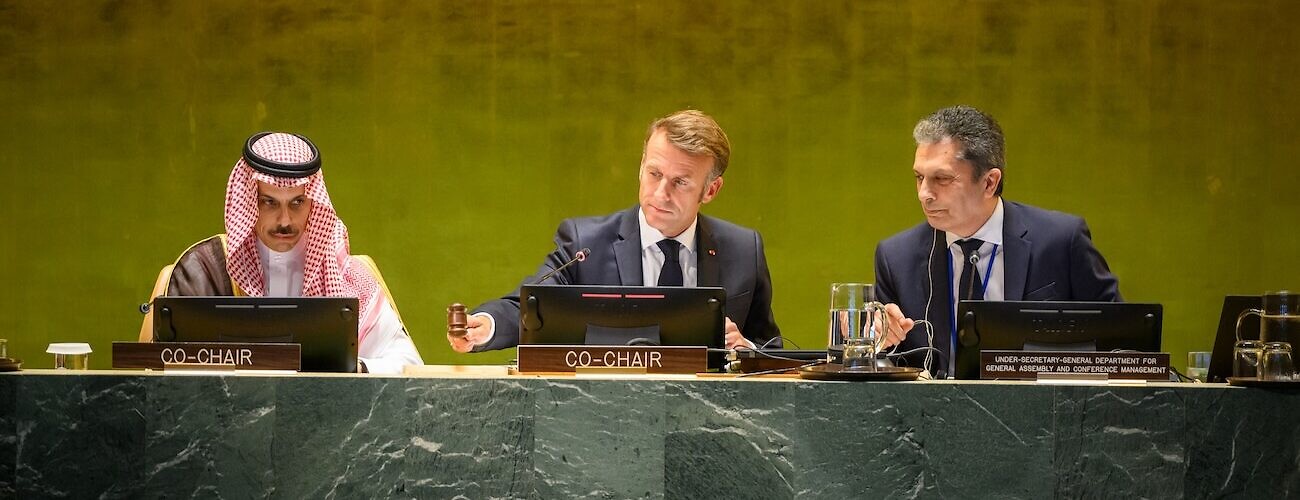
Emmanuel Macron gavels in the Conference for the Peaceful Settlement of the Question of Palestine and the Implementation of the Two-State Solution, September 22, 2025. UN Photo/Loey Felipe.
During the UN General Assembly in September 2025, a wave of countries—including Australia, Canada, France, Portugal, and the United Kingdom—officially recognized the State of Palestine, joining the 147 UN member states that had already done so.[1] Driven by mounting pressure to salvage the two-state solution and to achieve a ceasefire in Gaza, this marked a major strategic turn. For decades after the Palestine Liberation Organization declared independence in 1988, most Western countries insisted that formal recognition must follow a negotiated final peace agreement with Israel.[2] Yet as prospects for bilateral negotiations stalled, world leaders increasingly deployed recognition as a proactive diplomatic tool to establish an irreversible baseline for statehood.
While formal recognition keeps Palestine central to the global political agenda and carries moral weight, it has had little impact on Palestine’s ability to exercise sovereignty on the ground. Israel’s ongoing occupation exposes a stark divide between theoretical statehood and self-determination in practice. To bridge this divide, the international community should adopt policies of transformative recognition: translating formal recognition into concrete measures that expand Palestinian sovereignty, safeguard Palestine’s territorial integrity, and systematically reduce its administrative and economic dependency on Israel.
Why Recognition Alone Is Insufficient
International recognition carries legal, institutional, and symbolic value. Palestine’s status as a UN non-member observer state has enabled its accession to key treaties, access to the International Criminal Court (ICC) and the International Court of Justice (ICJ), and expanded diplomatic engagement—establishing a robust external posture of statehood.
However, formal recognition has failed to yield operational sovereignty. Israel maintains overriding control over critical state attributes—including borders, population registries, land, natural resources, external trade, and internal movement. Furthermore, many states that recognize Palestine continue to either acquiesce to the status quo or actively sustain it through economic, military, and other forms of support for Israel’s policies. This is in spite of the ICJ’s 2024 advisory opinion affirming the unlawfulness of Israel’s presence in the Occupied Palestinian Territory and placing explicit obligations on third states not to legitimize or assist in maintaining that unlawful situation.
Statehood is meaningful only when it comes with real self-determination. Without decisive multilateral action to challenge the mechanics of occupation, formal recognition risks remaining a hollow gesture that paradoxically entrenches the status quo rather than delivering true political agency to the Palestinian people.
From Principle to Practice
To pursue transformative recognition, states that recognize Palestine would align their policies with Palestinian self-determination and comply with their international legal duties. Rather than normalizing occupation-related constraints or conditioning progress on stalled negotiations, they would leverage recognition as a diplomatic tool to bring about immediate change. To operationalize this approach, UN member states should identify ways to translate recognition into practice. The four policy areas and measures outlined below are possible avenues, rather than an exhaustive framework, for doing so.
Diplomatic Relations: At present, states that recognize Palestine generally do not maintain fully accredited embassies to the State of Palestine. While some countries maintain separate consulates-general in Jerusalem or representative offices in Ramallah that conduct relations with the Palestinians, their status and operations remain shaped by the arrangements established under the Oslo Accords and by Israel’s control over accreditation, privileges and immunities, official travel, and access.
Transformative recognition requires states that recognize Palestine to gradually shift away from this framework and upgrade their representative offices in Ramallah to full embassies. This includes accrediting their representatives through the Palestinian Authority (PA) and seeking to conduct diplomatic relations in accordance with the Vienna Convention on Diplomatic Relations, to which Palestine acceded in 2014. Where Israeli restrictions prevent full implementation of these standards, both recognizing states and the PA should challenge rather than simply adapt to them. This could include coordinating responses when individual missions are targeted, pursuing legal or multilateral avenues when useful, and taking other steps to continue strengthening diplomatic relations with Palestine whenever possible.
Economic Relations: Under the Paris Protocol of 1994, which is part of the Oslo Accords, Israel exercises extensive control over Palestinian external trade, customs, and taxation. This situation has prevented the PA from diversifying its trade while maintaining the occupied territory as a “captive market” for Israeli goods and directing the overwhelming majority of Palestinian exports to Israel. These arrangements have also enabled Israel to unilaterally withhold Palestinian clearance revenues as a punitive measure, contrary to the Paris Protocol’s provisions. Under these conditions, the PA can do little to shape its external trade relations.
States pursuing transformative recognition can challenge these Israeli restrictions and treat Palestine as a distinct economic partner. This may entail adopting or expanding separate trade agreements with the PA, granting preferential access for Palestinian goods, recognizing Palestinian trade documentation for rules of origin, supporting Palestinian exporters, and facilitating alternative trade links with international markets, including through Jordan and Egypt, notwithstanding existing Israeli restrictions on external access and movement. While some states have taken measures in this direction, including the European Union and United Kingdom’s separate trade arrangements with the PA, their scope and practical impact remain limited.
Territorial Differentiation and Settlement Exclusion: In line with the ICJ’s 2024 advisory opinion, states that recognize Palestine should consistently distinguish between the territory of Israel and the Occupied Palestinian Territory, including East Jerusalem, and reject Israeli policies and practices that treat settlements and institutions located there as if they were within Israel. Transformative recognition would involve translating this distinction into systematic practice that goes beyond paying lip service to rejection of settlement policies.
Some recognizing states, particularly EU members and the UK, already apply such differentiation in their trade relations by excluding settlement goods from the preferential treatment accorded to Israeli products. More recently, several European states and Canada have announced, adopted or supported further restrictions on trade with Israeli settlements, going beyond the denial of preferential treatment. These developments illustrate how differentiation can evolve from a technical distinction into a more substantive policy aimed at preventing economic relations from contributing to the maintenance of the settlement regime.
Recognizing states that do not already apply this approach should adopt it and extend it consistently across other areas of relations with Israel. For example, settlement addresses and official documentation should not be treated as referring to locations within Israel, and the same territorial distinction should inform public funding, research and academic cooperation, investment, procurement, and other forms of state-supported engagement.
Population Registration, Passports, and Immigration Policy: Although the PA does issue identity documents and passports, the population registry on which these documents depend remains subject to Israeli control. This provides Israel with overriding power on questions of residency, family unification, and the movement of Palestinians and foreign nationals into and out of the occupied territory.
Transformative recognition could gradually reduce this dependency. As a first step, the PA should develop an independent legal framework for citizenship and assume greater control over its population registry and the issuance of passports and visas. In parallel, recognizing states should accept these travel documents and develop reciprocal visa and immigration arrangements.
Israeli control over Palestine’s borders, particularly at the Allenby Bridge and the Rafah Crossing, would continue to constrain the practical exercise of these powers. However, this does not prevent recognizing states from independently accepting Palestinian passports and visas for entry into their own territories while pressing Israel to respect Palestine’s authority over the movement of people into and out of its territory.
From Symbolism to Sovereignty
For decades, states around the world—including many that recognize Palestine—have affirmed their commitment to a two-state outcome while tolerating unlawful policies that render it impossible. Transformative recognition offers a practical framework to align diplomatic practice with the realization of Palestinian self-determination across diplomatic, administrative, economic, and territorial spheres.
Implementing this approach requires close coordination between recognizing states and Palestinian institutions. Together, they must systematically evaluate proposed measures, anticipate potential retaliatory actions, and establish targeted safeguards to mitigate risks and support Palestinian institutional resilience.
Palestinian sovereignty also depends on internal democratic legitimacy. A Palestinian government with a fresh mandate would provide international actors with a more legitimate counterpart—provided the legislative elections set for November 2026 proceed meaningfully across the West Bank, Gaza, and East Jerusalem and the results are respected. Governments should press now for full voting access, support election administration and observation, and commit in advance to engaging constructively with the outcome.
Ultimately, recognition must serve not as a symbolic end in itself but as an active leverage point to challenge occupation-related constraints and deliver material sovereignty on the ground.
[1] Eleven countries recognized Palestine as part of this wave: Andorra, Australia, Belgium, Canada, France, Luxembourg, Malta, Monaco, Portugal, San Marino, and the United Kingdom.
[2] In November 1988, the Palestine Liberation Organization (PLO) declared independence in the Palestinian territories occupied by Israel in 1967, encompassing the West Bank, including East Jerusalem, and the Gaza Strip.
Yehezkel Lein is the Director of the Research and Policy Unit at “A Land for All” and a Lecturer at the International Relations Department of the Hebrew University in Jerusalem. Rami Dajani is a political analyst based in Jerusalem.