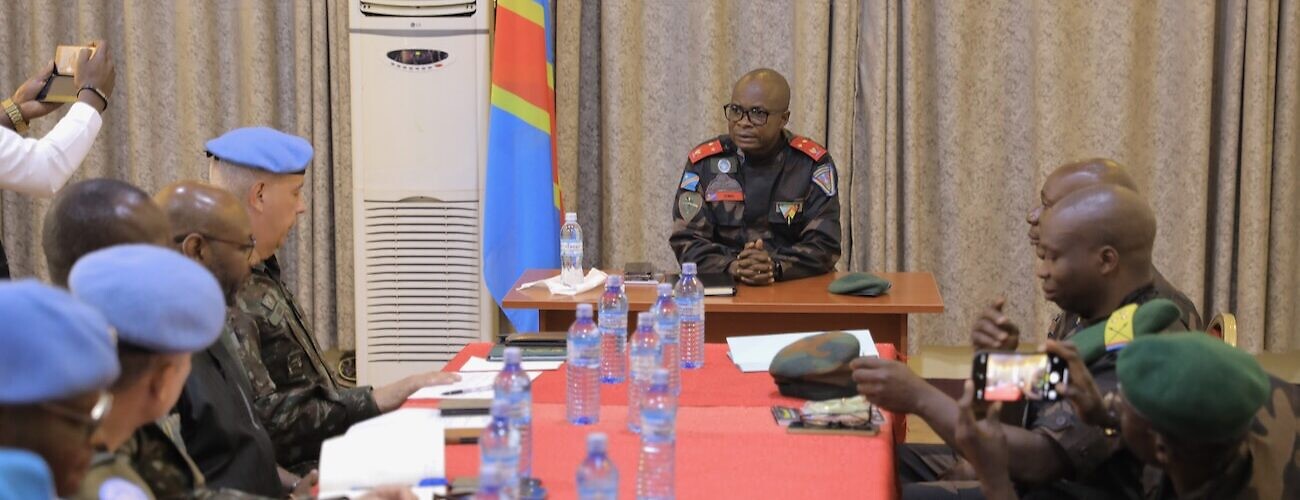
MONUSCO’s force commander and North Kivu’s governor discuss strengthening joint operations between MONUSCO and the Armed Forces of the Democratic Republic of the Congo in Beni, March 11, 2025. UN Photo/Ado Abdou.
Consent of the main parties to a conflict is both foundational and fundamental to UN peace operations. It provides the basis for the presence, purpose, and activities of UN field missions and distinguishes them from peace enforcement operations. Yet peace operations have increasingly faced a “crisis of consent,” impeding their operations and forcing several missions to draw down or withdraw.
In response, the UN secretary-general’s recent review on the future of all forms of peace operations recommended the idea of strategic-level compacts between the UN Security Council, UN Secretariat, and host states. A high-level political bargain that sets out a shared vision and mutual responsibilities for mandate implementation might help reset missions’ relationships with host countries. Yet such bargains are unlikely to come easily or to be a panacea for the manifold drivers of deteriorating consent.
An Eroding Ecosystem of Consent
There is no “one-size-fits-all” conception of consent: it is inherently context-specific, shaped by the characteristics of the conflict and the constellation of actors involved. While historically centered on sovereign state authorities, consent has increasingly been understood to include other parties to conflict, de facto authorities, political opposition, and local populations. Cooperation from each of these constituencies is often uneven and contested.[1] As a result, consent is increasingly complex and distributed across multiple levels. It is also dynamic throughout a mission’s life cycle, changing in response to shifting conflict dynamics, political interests, and relationships.
Across all these levels, missions have faced a marked deterioration in consent over the past five to ten years. From Sudan and the Democratic Republic of the Congo (DRC) to Mali, the Central African Republic, and Lebanon, consent from host governments, conflict parties, and local communities has fluctuated, waned, and, in some cases, been withdrawn altogether.[2] This trend has multiple drivers, including perceptions of missions’ inaction or overreach, gaps between expectations and implementation, the rise of alternative security providers, and a breakdown of political unity among the members of the UN Security Council.
The erosion of consent has manifested itself in multiple ways, ranging from obstruction and restrictions on freedom of movement—including persistent violations of the status of forces agreement, as in South Sudan—and constraints on deploying or using critical equipment to complete withdrawal of host-state consent, as in Mali. Degraded consent among segments of local populations, fueled by disinformation campaigns, has also resulted in hostility toward peacekeepers (e.g., in eastern DRC). All of these developments have impeded mandate implementation and, ultimately, the effectiveness of missions.
A Compact for Resetting Consent
In response to these trends, the secretary-general’s review builds on repeated appeals to strengthen mission–host state relations, calling for stronger partnerships with host states. Under the heading “towards a new partnership with host states,” the review makes three main recommendations and commitments relating to (1) the mandating process, (2) strategic-level compacts, and (3) more transparent and inclusive dialogue on the use of technological capabilities.
These calls for stronger partnerships with host states are important given the legal status they afford peace operations and the fact that peace operations work within an intergovernmental system. However, the focus on host governments risks crowding out consideration of other stakeholders, which are largely relegated to secondary “considerations” qualified by their “relevance” and what is deemed “appropriate.” By concentrating primarily on host states, the review misses an opportunity to advance more people-centered missions and address how missions can build and maintain consent among a wider range of stakeholders, including other parties to conflict and conflict-affected populations.
Regarding compacts, the review encourages the Security Council to consider “establishing a political mechanism or compact on mutual commitments between the Council, the Secretariat and the host State or States.”
While not a new idea, a specific strategic-level agreement between host countries and the Security Council has merit. A compact or joint political framework could:
- Enable a shift from treating host states as beneficiaries to partners and co-architects of stabilization and peacebuilding strategies;
- Generate “buy-in” to mission objectives from key stakeholders and make missions more tailored and responsive to demand rather than generic, templated, and supply-driven;
- More clearly “contractualize” cooperation, consolidating political support from the Council and altering host-country political incentives while giving missions and the Secretariat greater influence over the political process;
- Formalize mutual political commitments and clarify that UN support is conditional on cooperation;
- Enhance accountability by setting out reciprocal responsibilities for mandate implementation—what the UN will deliver and what other key parties, including host-state authorities, must guarantee;
- Outline a shared purpose and vision for the mission end state; and
- Broaden participation in the bargain, widening the range of stakeholders with vested interest in success.
There are, however, several challenges to realizing these potential benefits. Even in apparently “easy” cases, compacts will be difficult to craft and sustain.
First, the Security Council has historically failed to support inclusive processes around peace operations (e.g., by continuing to exclude troop- and police-contributing countries from the mandating process). As missions have become increasingly beholden to host-state governments, Council members, particularly the five permanent members and penholders, may resist greater inclusion.
Second, determining compact participants is difficult when political authority is contested. Even when the conflict parties are clear, identifying appropriate signatories amid divided or rapidly changing governments can be challenging. Selecting civil society and community-based representatives is equally sensitive, potentially empowering some while marginalizing others.
Third, government changes—whether constitutional (e.g., elections in the DRC) or otherwise (e.g., coups in Mali)—threaten continuity. New leaders may reject a predecessor’s compact or be hostile to the UN, making agreements potentially ephemeral.
Fourth, building punitive measures like sanctions into compacts to increase the costs of noncompliance may generate perceptions of paternalism rather than incentivize host-country cooperation.
Finally, compacts risk becoming simply another document—alongside mandates and mission strategies—that ends up sitting on a shelf.
What Will Make a Compact Work?
To overcome the challenges and harness the benefits, strategic-level compacts between the UN and host countries could incorporate several principles.
Iterative, Not Fixed: A compact should be a “living document” that reflects how the context might be changing and formalizes an ongoing dialogue. Focusing on process would avoid the straitjacket of a technical, one-size-fits-all approach and make the compact more flexible and tailored to the context. It would also allow iterative adaptation of the agreement to changing circumstances on the ground and political conditions. This would move away from treating consent as a one-off authorization at deployment toward viewing it as something continually negotiated and politically maintained.
As Inclusive as Practicable: The compact should be generated and updated through broad-based dialogue among key stakeholders. This means involving other host-country constituencies such as opposition political parties and more systematically incorporating input from civil society and local communities. The compact should also involve influential neighboring countries and regional arrangements, without which political solutions are unlikely to be attainable or durable. Likewise, bringing in a wider set of international actors, such as the international financial institutions (IFIs), UN agencies, funds, and programs through the UN country team, the Peacebuilding Commission, and the Peacebuilding Fund, could improve coherence and alignment. An inclusive agreement could help prevent situations where missions retain formal consent while losing the political and operational space needed to implement their mandates and advance political solutions.
A Focus on “Carrots,” Not “Sticks”: The opportunities for countries coming out of conflict, including the economic investment likely to flow in return for good-faith engagement, are often poorly understood. Including the IFIs and other donors in the compact process would allow these agreements to articulate the accompanying financial assistance and stabilization and peacebuilding support from extrabudgetary trust funds and Peacebuilding Fund programming, as well as longer-term support from the World Bank and other multilateral development banks. While it may not always be sufficient to induce host-government cooperation, making the economic opportunities explicit could incentivize compliance and raise the political costs of reneging on obligations. This focus on “mutuality” rather than “conditionality” is likely to be more effective than relying on noncredible threats and punitive measures.[3]
More Than Just an Integrated Development Framework: Alignment around a shared vision of peacebuilding and stabilization is essential to an effective compact. In many ways, this could reflect a similar approach as country-level UN sustainable development cooperation frameworks. However, peace operations are fundamentally different from development programs. They are not simply providing services or managing contractors. They have mandates to undertake sensitive activities, including human rights monitoring and the protection of civilians irrespective of the source of the threat, placing missions in a unique position vis-à-vis a range of host-country constituencies. Compacts therefore need to be bespoke political agreements.[4]
Not a Sine Qua Non for New Missions: The needs of conflict-affected societies will not always “fit the mold,” even when a broader spectrum of peace and security responses is seriously considered. A compact must not, therefore, become a nonnegotiable prerequisite for a UN mission where deployment could otherwise help to deescalate conflict or protect civilians. The nature of UN peace operations demands some tolerance of risk, and any move toward instantiating strategic-level compacts should not militate against agility and proven flexibility.
A New Vision for a New Secretary-General
Whoever takes António Guterres’s office on the 38th floor of the UN Secretariat building will need to put forward a new vision for peace operations to make them fit for purpose. Strengthening the partnerships undergirding missions, including, but also stretching beyond, host governments, could be one way of doing this. Compacts could help secure greater political support for missions from the Security Council while restoring missions’ leverage to promote political solutions to conflict.
This article draws on a research project commissioned by the Challenges Forum and the Folke Bernadotte Academy (FBA), including a background paper prepared for the forthcoming Challenges Annual Forum taking place on October 8, 2026, in New York, where host-country consent will be a major focus of discussion. Learn more about the CAF26.
[1] For example, where host-state authority is disputed or fragmented across different ministries or departments of government.
[2] While this article focuses on peacekeeping operations, this crisis of consent has also affected special political missions (e.g., Sudan, Iraq, Afghanistan, Somalia, and Yemen/Hudaydah).
[3] Geopolitical shifts in the Council mean that the “sticks” (e.g., targeted sanctions and arms embargoes) have weakened. Some countries are also too geopolitically important to be denied aid (e.g., Mali).
[4] One example of this emerged in the DRC, where joint transition and disengagement planning between the mission, UN headquarters, and the Congolese government produced a shared vision and aligned mutual commitments.