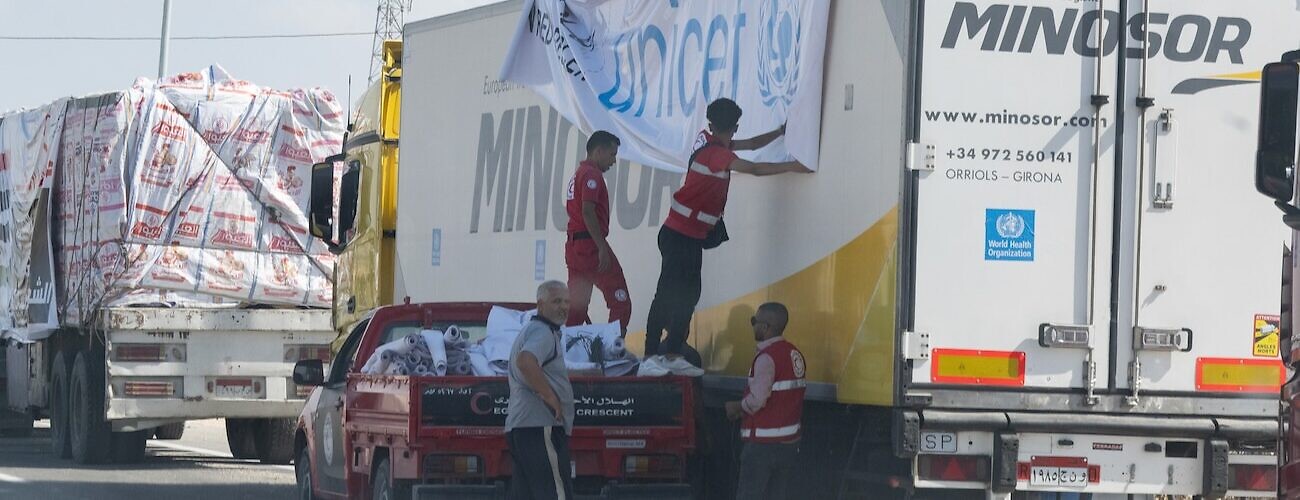
Aid workers load humanitarian supplies onto a truck near the Rafah border crossing between Egypt and Gaza, October 20, 2023. UN Photo/Eskinder Debebe.
On September 16th, at least 21 people were killed in Gaza City after a residential building collapsed. The building had been damaged during the war, but families decided to move back in because there was no alternative. According to the Norwegian Refugee Council, tent supplies are not entering Gaza. Caravans are barred. Israel has been blocking almost all reconstruction materials, so the repairs that might have kept the building standing were impossible to implement. This is the situation in Gaza a year into the ceasefire. There is no reconstruction or even recovery. People have to choose between a building about to collapse and no building at all.
As leaders gather in New York City for the 81st UN General Assembly, one year has passed since the Assembly endorsed the New York Declaration, and ten months since the UN Security Council adopted Resolution 2803 endorsing the 2025 Gaza peace plan and its Board of Peace. Yet there is no reconstruction in Gaza. Israel still holds more than half of the Gaza Strip because of its yellow line. The National Committee for the Administration of Gaza (NCAG) is still in Cairo, unable to return despite being vetted by Israel. Everything that Resolution 2803 and the Board of Peace promise depends on one thing: what crosses the border, and who decides.
What Crosses, and What Does Not
The terms of the ceasefire agreement required Israel to allow 600 aid trucks to enter Gaza daily. However, the number of aid trucks entering the Gaza Strip is much lower. On average, only 69 trucks entered Gaza per day in July and August 2026.
But the number of aid trucks is the wrong measure of recovery. The famine in Gaza has ended, and aid trucks and commercial trucks are bringing in food. But food is not the only thing needed to rebuild lives. Since the ceasefire, Israel has continued to expand its dual-use list to prevent the entry of basic items. The last official list Israel published dates from 2017, when the Israeli rights group Gisha won a legal battle forcing the Israeli government to make it public. That list built on the control list of the Wassenaar Arrangement, the international standard, adding 56 items requiring special approval across the Palestinian territories and 61 more for Gaza alone.
Nine years later, Israel has yet to publish another list. Hundreds of items have since been added to the list without being officially published. In November 2025, the UN counted 107 rejected requests for relief materials in a single month. Israel’s explanation was that the items were outside the humanitarian scope or were dual-use items. Documented rejections include deliveries of toilet seats, anesthetics, crutches, and dates, as well as a truck of intensive-care gurneys held on the Egyptian side because one pallet was plastic rather than wood. In August, Israel approved an Emirati-backed housing pilot inside its zone of control in eastern Rafah but still barred caravans from entering even there.
In effect, the list has been replaced by practice: the same item passes for one organization and is refused for another. For example, Israel has refused aid agencies permission to bring in generators and metal pallets even while allowing commercial traders in Gaza to bring in similar items through the same checkpoint.
The diplomats and humanitarian workers I speak with say the border today is harder to navigate than at any point since October 7, 2023, including during the famine. Food enters, but everything else does not. And every month, another obstacle is added.
Gaza Has Been Here Before
The Gaza Reconstruction Mechanism (GRM) was brokered on September 16, 2014, by UN Special Coordinator Robert Serry between Israel and the Palestinian Authority (PA) as a temporary arrangement to let building materials into Gaza on terms Israel accepted. Nickolay Mladenov, now the Board of Peace’s high representative, took over the UN office the following year and administered it for nearly six years.
The GRM’s procedures were anything but simple. The PA identified each reconstruction need, which went into a joint database that Israel could inspect. Each project passed through a steering team, then to the Coordinator of Government Activities in the Territories (COGAT), the Israeli military body that held “a security veto over the entry of all items.” Then, if approved, it went into an electronic coupon that fixed the quantity of cement, aggregate, and steel a family could buy from a vendor the UN monitored.
This process gave Israel several opportunities to say no, and it is why reconstruction took years. Despite Israel’s commitment to process dual-use requests within 45 working days, it did not meet that deadline. By 2020, Palestinian agencies and vendors were therefore bypassing the mechanism, coordinating directly with the Israeli liaison office or turning to the black market. In the water and sanitation sector alone, the annual submissions to the system fell from 3,749 to 11 between 2017 and 2020. Yet the system was never retired. In the words of Oxfam, “Temporary is the new permanent.” In 2024, the International Court of Justice cited the mechanism as evidence that Israel continued to exercise effective control over Gaza after its 2005 withdrawal.
One of the key differences between the GRM of 2014 and today’s Board of Peace is the Palestinian role. In the GRM, the PA signed the agreement but had no decision-making authority. In 2026, the only Palestinian institution included in the roadmap is NCAG, which was created by the Board and answers to it and still cannot enter Gaza. What began as subordination in the GRM is being written into the next mechanism as a substitution.
The lack of Palestinian agency has costs on the ground. Under the GRM, rebuilding the majority of the damage from 2014 took roughly six years. But the destruction since October 2023 is 20 times greater. At the GRM’s pace, it would take 120 years to rebuild what was destroyed in Gaza. A reconstruction that Palestinians do not control is not a Palestinian-led reconstruction, whatever the roadmap calls it, and the record says it will not be a fast one either. This lack of Palestinian agency would only lead to more violence and instability.
Clause 15 and the Veto That Moved
Let’s read the Board of Peace’s roadmap with that history in mind. Clause 15 places reconstruction under a plan “prepared and supervised by [the Board of Peace] and NCAG in accordance with relevant laws and international standards.” In other words, this is the GRM’s structure with a few names changed. There is still an external supervisor, a Palestinian body responsible only for delivery, and no one is named as controlling entry into Gaza.
But the Israeli veto has expanded. Resolution 2803 endorses an Israeli security perimeter that remains until Gaza is “properly secure” and ties Israeli withdrawal to demilitarization milestones. The Board’s own Davos planning presentation says reconstruction proceeds “only in sectors with full disarmament.” The logic of dual use no longer applies only to reconstruction materials. It has been absorbed into a wider architecture that controls the entire future of the Gaza Strip. Israel now decides what enters Gaza, which organizations are eligible to work, and when the committee that administers Gaza can set foot in it.
The Board of Peace’s roadmap has detailed steps running only one way. One of its core provisions is the phased, verified decommissioning of Hamas’s weapons, matched by a staged Israeli withdrawal and reconstruction in certified areas. Certification is done by an International Verification Committee made up of the deal’s guarantors, the Board of Peace itself, and the International Stabilization Force. The same precision does not apply in the opposite direction. Crossings are not a step in that sequence. Israel’s obligations on the entry of goods, shelter material, or the needed 600 trucks daily have no inspector, no deadline, and no trigger. Mladenov himself said this month that the hurdles include Israeli limits on construction materials and aid and that “we are very far from reconstruction but need to move forward with early recovery.” This is not a malfunction of the system. It is the system working exactly as written.
The Test in New York
What the past teaches us is simple. Whoever controls Gaza’s borders will control the pace and shape of the recovery. An Israeli mechanism built around a veto did not deliver reconstruction. The solution is Palestinian administration of the crossings, guided by international agreements that all parties, including Israel, can rely on. This is not untested. Israel signed the 2005 Agreement on Movement and Access, which put the PA in charge of operating the Gaza side of Rafah, with the European Union monitoring the crossing with a live video feed to Israel.
The past also teaches us about who should be writing the plan. The Board of Peace was designed and is currently chaired by people who are not Palestinian. This lack of Palestinian agency will only worsen the situation. There are Palestinian plans already on the table, such as the Gaza Phoenix Initiative, drafted by a coalition of Palestinian architects, urbanists, and researchers, or the Arab plan Egypt presented in March 2025. These plans should guide any future arrangements.
Yet even these Palestinian plans too often prioritize the demands of Israel. During the past several years, I have reviewed every major non-Palestinian reconstruction plan. Every one of them treats Gaza’s border as a security question to be settled by whatever satisfies Israel, never as a governance question for Palestinians.
States committed to Gaza’s reconstruction have a chance to rectify this. In New York City, states will be asked to finance Gaza’s reconstruction and contribute more personnel to the International Stabilization Force. It has been widely reported that the Board has received little to nothing from donors. The governments now being asked to fund the Board and contribute to the stabilization force can use this as leverage. They can make their contributions conditional on a border arrangement that puts a Palestinian institution at the crossings. The Board of Peace’s next six-monthly report under Resolution 2803 is due in November. Before it submits this report, the governments gathered in New York City should ask the Board one question and hold it to the answer: Who will control the border in Gaza, and by what right? This will determine whether Gaza’s reconstruction will take a decade or a century.
Without a clear answer to this question, the Board of Peace will have repackaged the GRM once again. This time, however, we have 20 times the scale of destruction and an Israeli veto that extends from a database to the map. The Palestinian families that moved into the damaged buildings because there were no tents will spend years waiting. Recovery has to come before reconstruction, and it all starts at the border.
Mohammed Mourtaja is a Palestinian development policy specialist and writer from Gaza working on post-conflict reconstruction and governance. He holds an MPhil in development studies from the University of Cambridge and is the founder of GazaIndex.